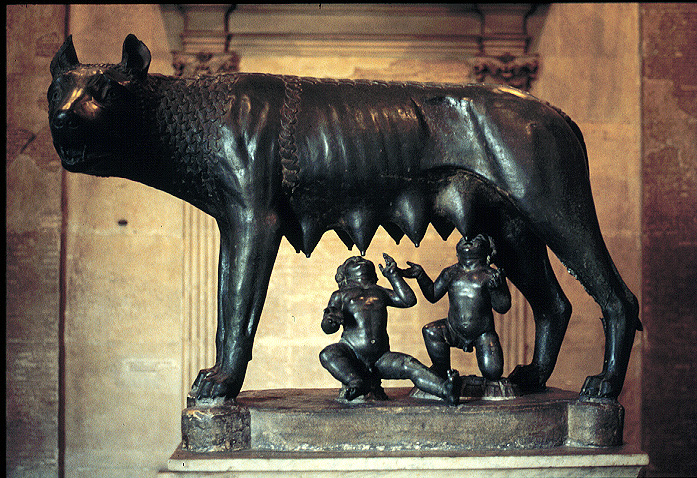
‘’ Capitoline Wolf ‘’

Capitoline Wolf / Rome, Italy
Period: 500-480 BCE

The Capitoline wolf is a representation of the ancient legend of the founding of Rome. The twin babies represented here are Romulus and Remus. In the legend the twins grandfather was overthrown by his brother, and the brother ordered the twins to be cast into the Tiber River. However they were rescued by a she-wolf who cared for them until they could be taken in by a herdsmen. Later when Romulus and Remus became adults, they took back their grandfathers kingdom and decided to establish a city. They quarreled and the brother Romulus killed his brother Remus, thus beginning the history of Rome with a fratricide.

The Wolf shown here is made out of bronze, and is a good example of what some of the first sculptures were like in ancient Rome. The rib cage of the wolf along with many of its bones are shown making the wolf seem almost sickly.
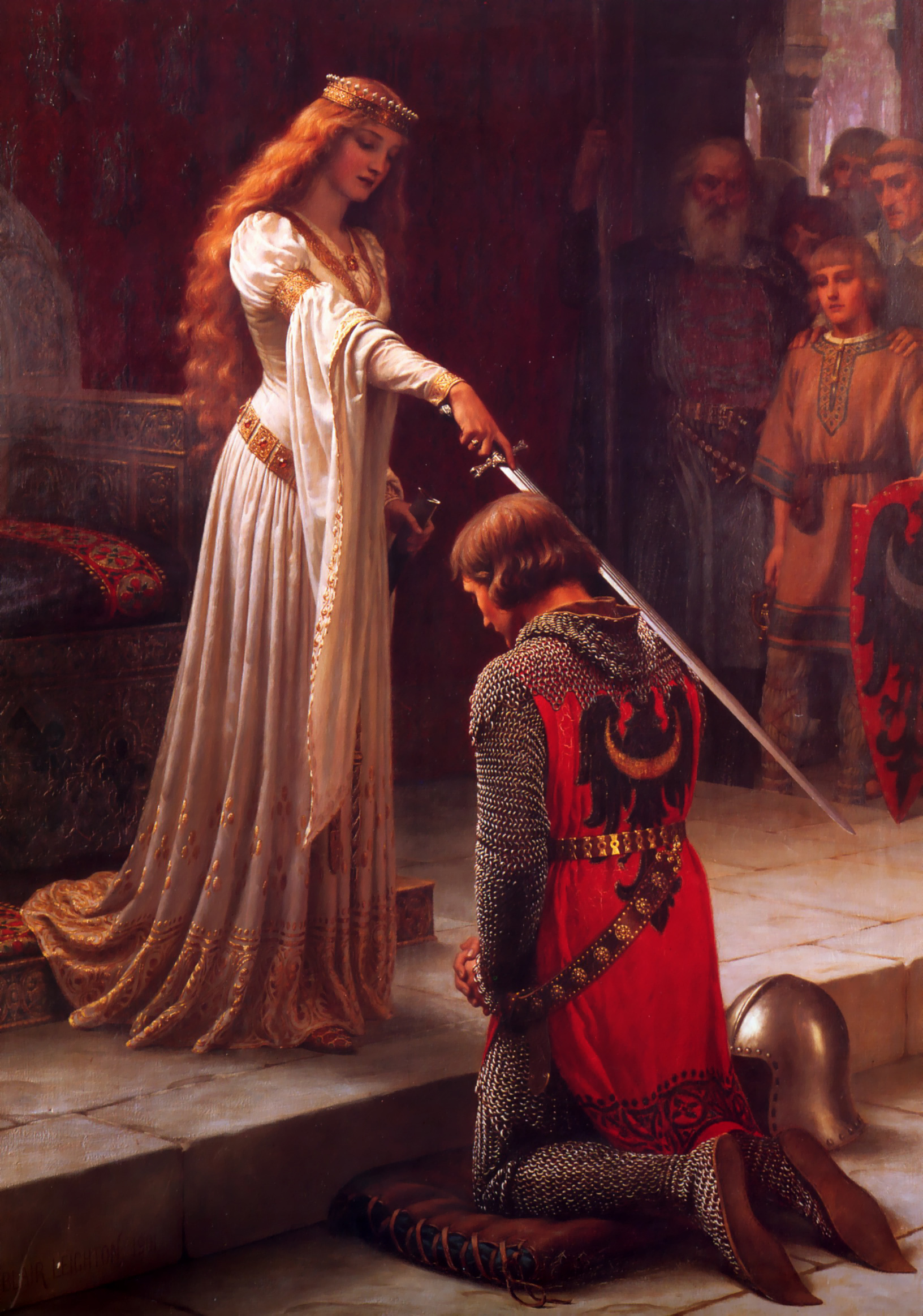
” The Accolade ”

The Accolade ”  by Edmund Blair Leighton . Year 1901 / oil painting

The Accolade is a finely detailed painting set in medieval times showing a beautiful red haired Queen knighting a young man. This is a very romantic painting with the fair maiden and the handsome and brave young man. The Knight is bowed at her feet in a position of obedience. To the left of the queen we can see the audience gathered to witness the knighting. They appear to be watching the lovely queen with rapt attention. There is no king on display in this painting and clearly the painter intends for our eye to focus on the beautiful queen. The picture makes one think of the famous Queen Guinevere and Sir Lancelot. One can easily imagine a whole background story to this painting. One has the feeling that the young queen in this painting has feelings of tenderness and even love for the young man at her feet. Most likely she is not able to act upon her feelings for this young Knight. Perhaps because the painting is so reminiscent of Lancelot and Guinevere, one can’t help but think that although they probably truly love one another, as with most good love stories they will come to a tragic end. Perhaps the young Knight is about to head off into a battle from which sadly, he will never return.

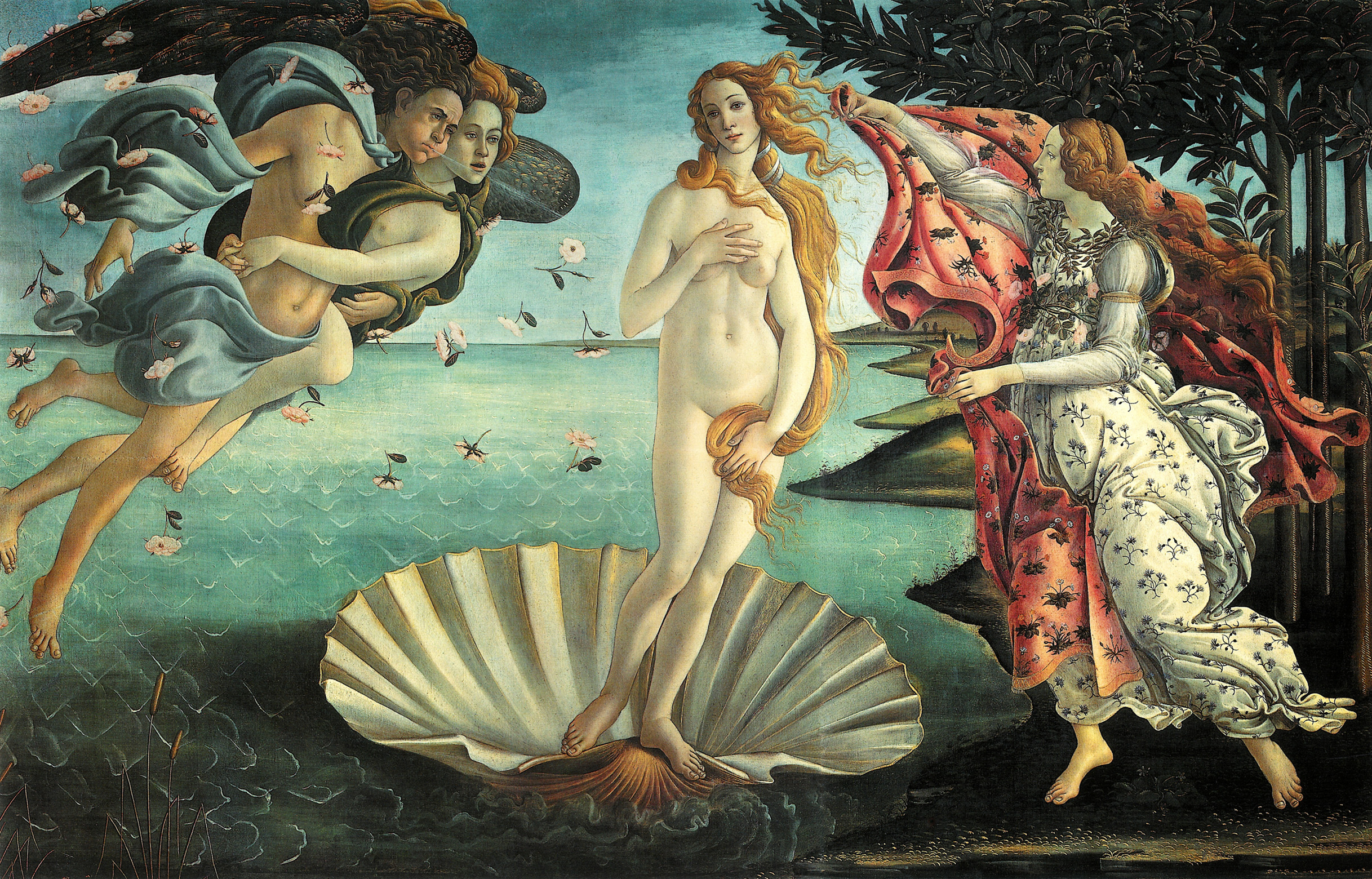
” The Birth of Venus ”

The Birth of Venus is undoubtedly one of the world’s most famous and appreciated works of art. Painted by Sandro Botticelli between 1482 and 1485, it has become a landmark of XV century Italian painting, so rich in meaning and allegorical references to antiquity.

Venus, according to the Greek poet Hesiod who wrote the Theogony, wasborn out of sea foam. Ancient mythology is filled with blood and violence and this story is not an exception. The story goes that the God Uranus had a son named Cronus who overthrew his father, castrating him and throwing his genitals into the sea. This caused the water to be fertilised, and Venus was born.

After her birth she came ashore on a shell, pushed along by the breath of Zephyrus, the god of the west wind. In the painting we see Zephyrus embracing the nymph Chloris. The girl about to cover Venus with a flowery mantle is thought to be one of the Hours. They were the mythological handmaidens of Venus who also had power over the natural cycle of the seasons. The island she arrives at is Cyprus, or Citharea.

The breath of Zephyrus was believed to have the power to fertilise and create new life. His embrace with the nymph symbolises the act of love.

[Austrian National Library , State Hall]

The State Hall, the heart of the Austrian National Library, is one of the most beautiful library halls in the world. It is the biggest Baroque library in Europe.

The former Court Library was created in the first half of the 18th century as a private wing of the Hofburg imperial residence. Emperor Karl VI. ordered its construction. The library was built by Joseph Emanuel Fischer von Erlach according to plans of his father, Johann Bernhard Fischer von Erlach.

The impressive state hall of the library is almost 80 m long and 20 m high and is crowned by a dome that is magnificently decorated with frescoes by the court painter Daniel Gran. More than 200,000 volumes are exhibited here, among them the comprehensive library of Prince Eugene of Savoy as well as one of the largest collections of Martin Luther’s writings from the Reformation Era.

” The Entrance to the Grand Canal, Venice by Canaletto / Year: 1730 ”

The Entrance to the Grand Canal, Venice by Canaletto

“The Entrance to the Grand Canal, Venice” by Canaletto portrays the Rococo landscape of the entrance to the Grand Canal, Venice. The composition is a veduta, a word derived from the Italian for “view”, which means a highly detailed, large-scale painting of a cityscape or some other vista.

This Canaletto is a typical example of the ‘vedute paintings’ popular with Grand Tour travellers of the 1700s as a visual record of their travels. Canaletto was one of the more famous painters of city views or vedute, especially of Venice. From 1746 to 1756 he worked in England where he created many paintings of the sights of London. He was highly successful in England and became famous thanks to the British merchant and connoisseur Joseph Smith who sold his large collection of Canaletto’s paintings to King George III in 1762. Canaletto’s paintings became highly prized as during the 18th century European monarchs vied for his grandest pictures.

Many of Canaletto’s paintings can be found in museums across the world, depict highly detailed, usually large-scale paintings of Venetian other famous cityscapes or vistas.

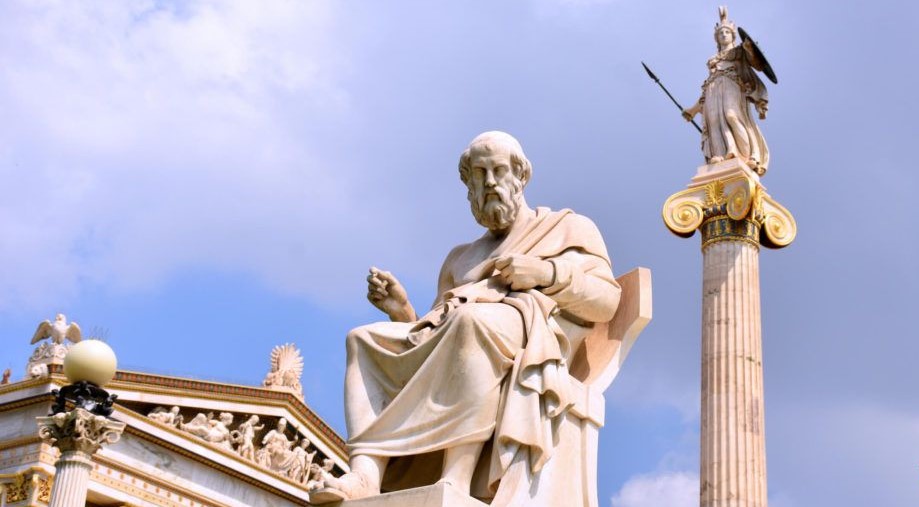
” Plato ”

Short Biography

Plato (423 BC – 348 BC) was a Classical Greek philosopher, mathematician, student of Socrates, writer of philosophical dialogues, and founder of the Academy in Athens – the first institution of higher learning in the Western world. Along with his mentor, Socrates, and his student, Aristotle, Plato helped to lay the foundations of Western philosophy and science. Plato influenced a whole range of subjects from philosophy to maths, logic and ethics.

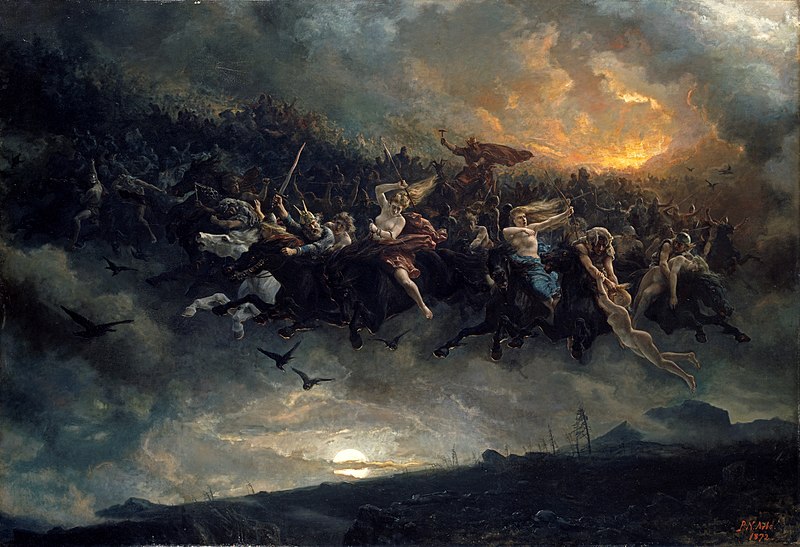
” The wild Hunt of Odin ”

year 1872 / by Peter Nicolai Arbo

The painting is based on the Wild Huntmotif from folklore and Norse mythology. In the Scandinavian tradition, the Wild Hunt is often associated with the god Odin who leads a terrifying procession of gods, trolls and restless souls that hurl across the sky during midwinter and abduct unfortunate people who have failed to find a hiding place

” The Starry Night ”

”The Starry Night”

by Vincent van Gogh

Date Created 1889 /Saint-Rémy-de-Provence

Vincent van Gogh painted Starry Night in 1889 during his stay at the asylum of Saint-Paul-de-Mausole near Saint-Rémy-de-Provence. Van Gogh lived well in the hospital; he was allowed more freedoms than any of the other patients. If attended, he could leave the hospital grounds; he was allowed to paint, read, and withdraw into his own room. He was even given a studio. While he suffered from the occasional relapse into paranoia and fits – officially he had been diagnosed with epileptic fits – it seemed his mental health was recovering.
Unfortunately, he relapsed. He began to suffer hallucination and have thoughts of suicide as he plunged into depression. Accordingly, there was a tonal shift in his work. He returned to incorporating the darker colors from the beginning of his career and Starry Night is a wonderful example of that shift. Blue dominates the painting, blending hills into the sky. The little village lays at the base in the painting in browns, greys, and blues. Even though each building is clearly outlined in black, the yellow and white of the stars and the moon stand out against the sky, drawing the eyes to the sky. They are the big attention grabber of the painting.

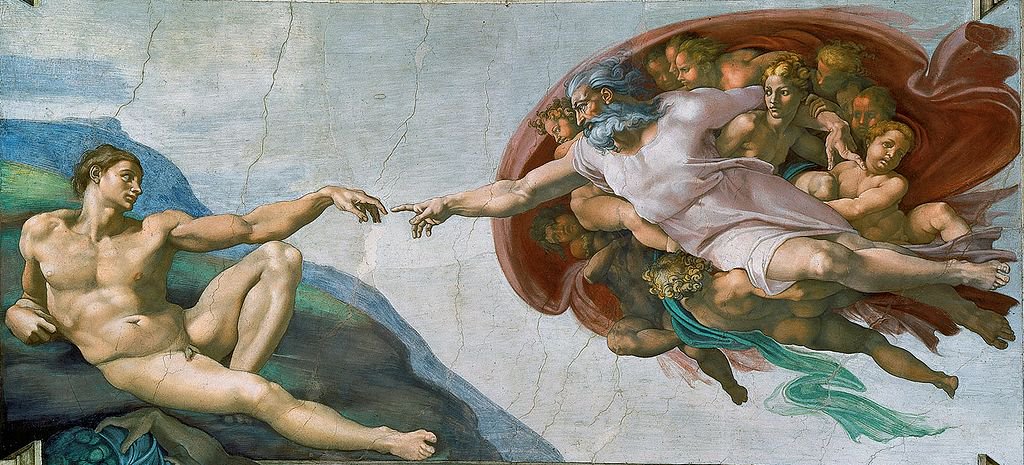
” Creation of Adam ” by Michelangelo

The panel of The Creation of Adam in the Sistine Chapel must be one of the most known images in the world.
Completed by Michelangelo circa 1511, it depicts God the father creating Adam, the first man and was amongst the last panels to be completed, telling the story of Genesis. The focal point of the episode of the Creation of Adam painting is the contact between the fingers of God and those of Adam, through which the breath of life is transmitted. By not painting the fingers of God and Adam touching and leaving a small space between the two, Michelangelo creates a tingling tension, an anticipation of that wonderous moment, as we all wait for God to complete his Creation of Adam.

Michelangelo’s languid Adam was probably inspired by Ghiberti’s Adam on his Doors of Paradise of the baptistery in Florence. Whereas in his, The Creation of Eve, Michelangelo borrows heavily from Jacopo della Quercia’s version on the portal of San Petronio in Bologna. In the Eve panel Michelangelo did not use foreshortening, making the figures difficult to see clearly from the floor of the chapel. In the Creation of Adam, the great artist addresses this problem, with an obvious focus on the enlarged figures of God and Adam.

The painting of Michelangelo’s Creation of Adam only took two to three weeks to complete, while the actual painting of Adam took Michelangelo only four days! An admiring Vasari (1511 – 1574) gasped with amazement and said, “a figure of such a kind in its beauty, in the attitude and in the outlines, that it appears as if newly fashioned by the first and supreme Creator rather than by the brush and design of mortal man.” Today we see the Creation of Adam as a masterpiece within a masterpiece.