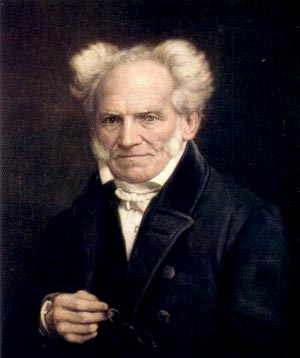
[Arthur Schopenhauer]

Title: Arthur Schopenhauer

Author: Jules Lunteschütz

Year: 1855

[Biography]

Arthur Schopenhauer was born on 22 February 1788 in Danzig, Prussia (nowdays Gdańsk, Poland), one of the greatest philosophers ever lived.He was the son of Johanna Schopenhauer (née Trosiener) and Heinrich Floris Schopenhauer, both descendants of wealthy German families. In 1805, Arthur’s father ended his life by committing suicide. From then on, his mother took over his upbringing, and in 1807, Arthur was enrolled in a gymnasium in Gotha. 

 In 1809, Arthur was accepted at the University of Göttingen, where he pursued a degree in medicine. He also studied philosophy under the direction of G.E. Schulze, who regularly assigned him philosophical readings, his interests were especially peaked by the works of Plato and Immanuel Kant, and they had a significant influence in shaping his ideologies.

In 1813, Schopenhauer received his Ph.D. in philosophy from the University of Jena.

In 1816, Schopenhauer published his most remarkable and highly applauded work, titled ”The World as Will and Representation”, which has influenced economic thought for centuries.

In March 1820, after a lengthy first tour of Italy and a triumphant dispute with Hegel, he qualified to lecture at the University of Berlin. Though he remained a member of the university for 24 semesters, only his first lecture was actually held; for he had scheduled (and continued to schedule) his lectures at the same hour when Hegel lectured to a large and ever-growing audience. Clearly, he could not successfully challenge a persistently advancing philosophy. Even his book received scant attention. For a second time Schopenhauer went on a year-long trip to Italy, and this was followed by a year of illness in Munich. In May 1825 he made one last attempt in Berlin, but in vain. He now occupied himself with secondary works, primarily translations.

 After an unsuccessful period of lectureship in Berlin prior to 1831 he settled in Frankfurt am Main, where he led a solitary life and became deeply involved in the study of Buddhist and Hindu philosophies and mysticism where he seems to have found echoes of the approach to philosophy that he was independently working on.

He published the essay ‘On the Freedom of the Will’ in which he tried to answer the academic question “Is it possible to demonstrate human free will from self-consciousness?” which was posed by the Royal Norwegian Society of Sciences in 1839.

He published a second edition of ”The World as Will and Representation” in 1844. The first was a virtual reprint of the original, and the second was a collection of essays expanding topics covered in the first. The important topics covered in the work were his reflections on death and his theory on sexuality.

He devoted his time to research and reading, and in 1847, he published a revised version of his early works, titled On the Fourfold Root of the Principle of Sufficient Reason”.

In 1851, he wrote an essay ‘Of Women’ in which he described the women as less reasonable and lacking the capacity to make decisions. In the essay he also referred to women as the “weaker sex”.

Though he enjoyed a robust health, but in 1860 his health began to deteriorate and he died of heart failure on 21 September 1860 while sitting at home on his couch with his cat.

Schopenhauer never married but had a relationship with Caroline Richter, an opera singer, beginning in 1821.

He believed that the actions of all human beings lacked direction and that desire is the root of all evils. According to him, pain and suffering are directly proportional to desire as it creates frustration upon the failure of attaining a particular goal or object.

He was of the opinion that desire never ends which means after achieving something the desire for a new goal creeps in. This is a cycle which continues for an indefinite period..

This great philosopher’s works and teachings inspired a number of philosophers – Richard Wagner, Friedrich Nietzsche, Jorge Luis Borges and to some extent Sigmund Freud.
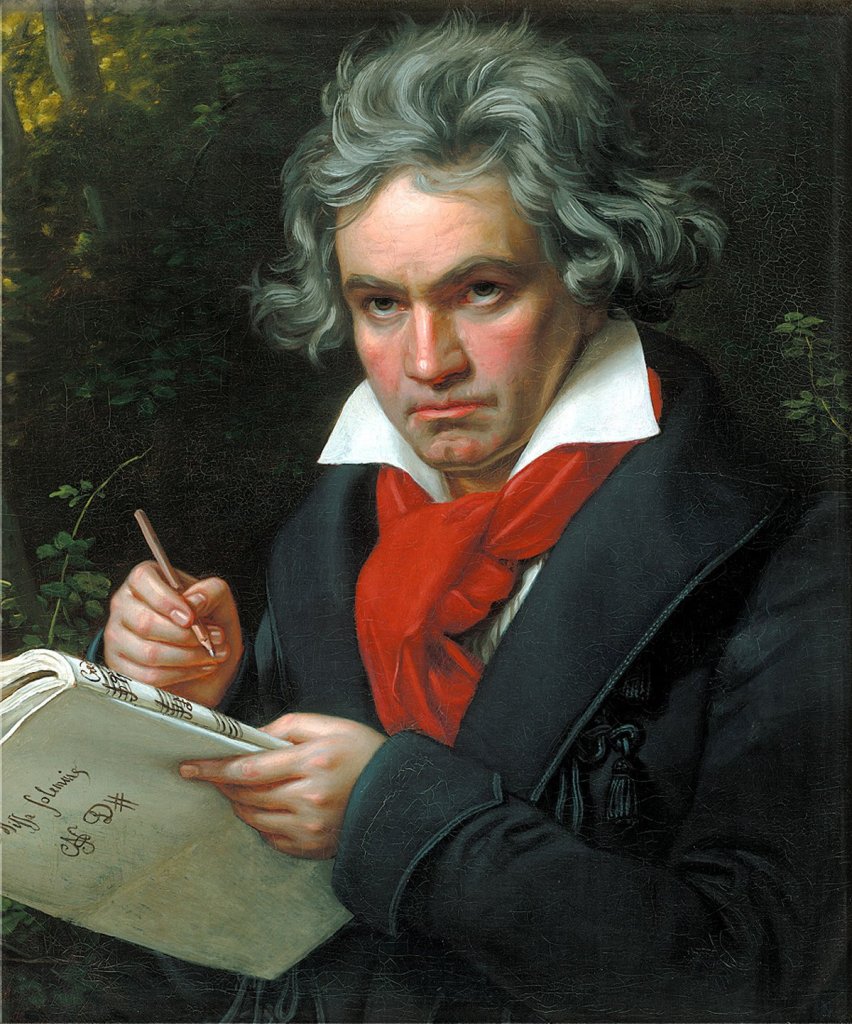
”Ludwig van Beethoven”

Portrait of Ludwig van Beethoven

Author: Karl Joseph Stieler

Year: 1820

Medium: oil on canvas

Location: Beethoven-Haus

[Biography]

Beethoven was born in Bonn, Germany, to Johann van Beethoven (1740-1792), of Flemish origins, and Magdalena Keverich van Beethoven (1744-1787). Until relatively recently 16 December was shown in many reference works as Beethoven’s ‘date of birth’, since we know he was baptised on 17 December and children at that time were generally baptised the day after their birth. However modern scholarship declines to rely on such assumptions.

Beethoven’s first music teacher was his father, who worked as a musician in the Electoral court at Bonn, but was also an alcoholic who beat him and unsuccessfully attempted to exhibit him as a child prodigy. However, Beethoven’s talent was soon noticed by others. He was given instruction and employment by Christian Gottlob Neefe, as well as financial sponsorship by the Prince-Elector. Beethoven’s mother died when he was 17, and for several years he was responsible for raising his two younger brothers.

Beethoven moved to Vienna in 1792, where he studied with Joseph Haydn and other teachers. He quickly established a reputation as a piano virtuoso, and more slowly as a composer. He settled into the career pattern he would follow for the remainder of his life: rather than working for the church or a noble court (as most composers before him had done), he was a freelancer, supporting himself with public performances, sales of his works, and stipends from noblemen who recognized his ability.

Beethoven’s career as a composer is usually divided into Early, Middle, and Late periods.

In the Early period, he is seen as emulating his great predecessors Haydn and Mozart, at the same time exploring new directions and gradually expanding the scope and ambition of his work. Some important pieces from the Early period are the first and second symphonies, the first six string quartets, the first two piano concertos, and about a dozen piano sonatas, including the famous ‘Pathétique’.

The Middle period began shortly after Beethoven’s personal crisis centering around deafness, and is noted for large-scale works expressing heroism and struggle; these include many of the most famous works of classical music. The Middle period works include six symphonies (Nos. 3 – 8), the last three piano concertos and his only violin concerto, six string quartets (Nos. 7 – 11), many piano sonatas (including the ‘Moonlight’, ‘Waldstein’, and ‘Appassionata’), and Beethoven’s only opera, Fidelio.

Beethoven’s Late period began around 1816 and lasted until Beethoven ceased to compose in 1826. The late works are greatly admired for their intellectual depth and their intense, highly personal expression. They include the Ninth Symphony (the ‘Choral’), the Missa Solemnis, the last six string quartets and the last five piano sonatas.

Beethoven’s personal life was troubled. Around age 28 he started to become deaf, a calamity which led him for some time to contemplate suicide. He was attracted to unattainable (married or aristocratic) women, whom he idealized; he never married. A period of low productivity from about 1812 to 1816 is thought by some scholars to have been the result of depression, resulting from Beethoven’s realization that he would never marry. Beethoven quarreled, often bitterly, with his relatives and others, and frequently behaved badly to other people. He moved often from dwelling to dwelling, and had strange personal habits such as wearing filthy clothing while washing compulsively. He often had financial troubles.

It is common for listeners to perceive an echo of Beethoven’s life in his music, which often depicts struggle followed by triumph. This description is often applied to Beethoven’s creation of masterpieces in the face of his severe personal difficulties.

Beethoven was often in poor health, and in 1826 his health took a drastic turn for the worse. His death in the following year is usually attributed to liver disease.

[SOURCE:8notes.com]