

Title: The artist dreaming in his workshop
Author: Emile-Louis Foubert
Medium: oil on canvas
Year: 1886

Title: The artist dreaming in his workshop
Author: Emile-Louis Foubert
Medium: oil on canvas
Year: 1886

Title: Medusa
Author: Caravaggio
Year: 1597
Style: Baroque
Genre: mythological painting
Media: oil, canvas
Location: Uffizi Gallery, Florence, Italy
Medusa was a Gorgon monster, a terrifying female creature from the Greek Mythology. While descriptions of Gorgons vary across Greek literature, the term commonly refers to any of three sisters who had hair of living, venomous snakes, and a horrifying visage that turned those who beheld it to stone. Traditionally, while two of the Gorgons were immortal, Stheno and Euryale , their sister Medusa was not, and was slain by the mythical hero Perseus, the legendary founder of Mycenae and of the Perseid dynasty. According to the story, she was killed by Perseus, who avoided direct eye contact by using a mirrored shield. After Medusa’s death, her decapitated head continued to petrify those that looked at it.
[SOURCE:wikiart.org]
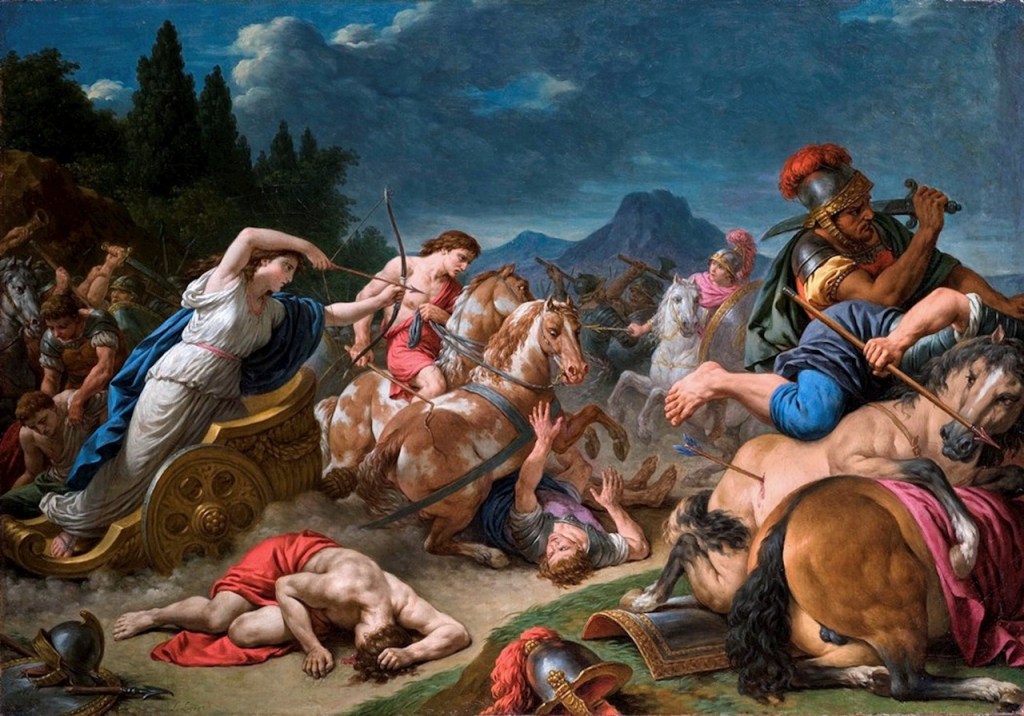
Title: Bellona Calling Mars to War
Author: Lagrenée, Louis Jean François
Year: 18th century
Medium: Oil on canvas
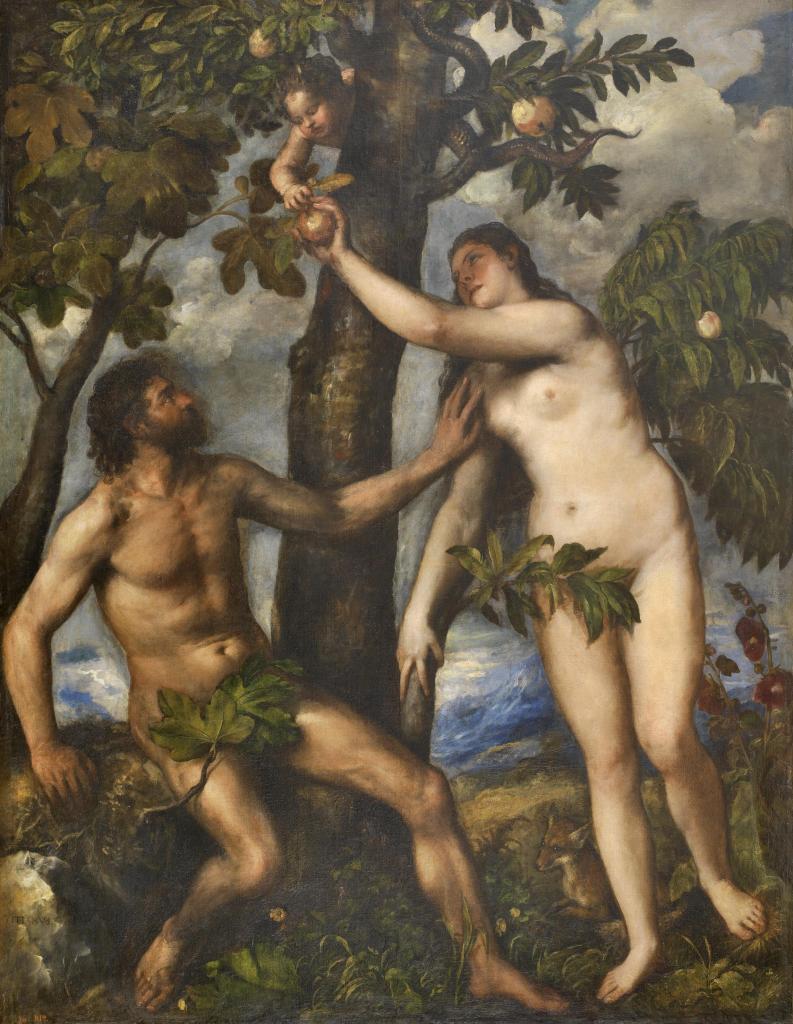
Title: The Fall of Man
Author: Titian
Year: 1550
Style: Mannerism
Genre: religious painting
Media: oil, canvas
Location: Museo del Prado, Madrid, Spain

Author: Hubert Robert
Year: 18th century
Title: The Bathing Pool
Location: Metropolitan Museum of Art
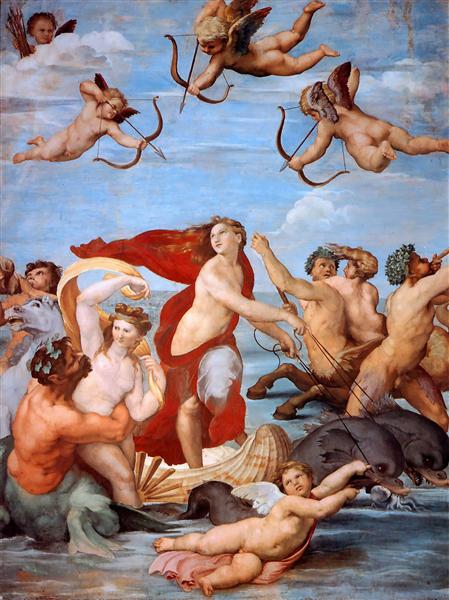
Title: The Triumph of Galatea
Author: Raffaello Sanzio da Urbino
Year: 1512
Style: High Renaissance
Genre: mythological painting
Location: Villa Farnesina, Rome, Italy
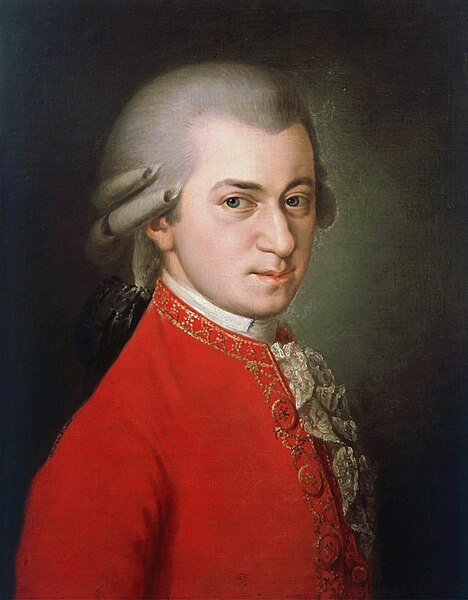
Title: Wolfgang Amadeus Mozart
Author: Barbara Krafft
Year: 1819
“Music is my life and my life is music. Anyone who does not understand this is not worthy of God.”
– Wolfgang Amadeus Mozart.
Mozart Biography
Wolfgang Amadeus Mozart (27 January 1756–5 December 1791) was one of the most influential, popular and prolific composers of the classical period.
Mozart was born in Salzburg to a musical family. From an early age, the young Mozart showed all the signs of a prodigious musical talent. By the age of five, he could read and write music, and he would entertain people with his talents on the keyboard. By the age of six, he was writing his first compositions. Mozart was generally considered to be a rare musical genius, although he was also diligent in studying other great composers such as Haydn and Bach. During his childhood, he would frequently tour various palaces around Europe playing for distinguished guests.
He created twenty-four operas including such famous works as “The Magic Flute”, “Don Giovanni” and “The Marriage of Figaro”, seventeen masses and over fifty symphonies. Mozart’s work, however, extended to all styles and types of music. He knew how to blend traditional and contemporary elements to create his own distinctive style, which is characterized by thematic and tonal variety, melded with a high degree of formal discipline. Mozart’s compositions live from their melodic, rhythmic and dynamic contrasts.
In 1791, on the 5th of December, Mozart died at the age of 35. However, the cause of his death still remains vague and researchers have listed at least 118 probable causes of his death. Legacy Though Mozart lived only for 35 years, Mozart’s legacy is unparalleled. With almost 600 musical pieces, Mozart’s influence reigns supreme in all the genres of music ranging from symphonies, concertos, operas, chamber music to piano solo. He is undoubtedly one of the greatest musicians ever, if not the greatest.
Source: biographyonline.net
 European Culture