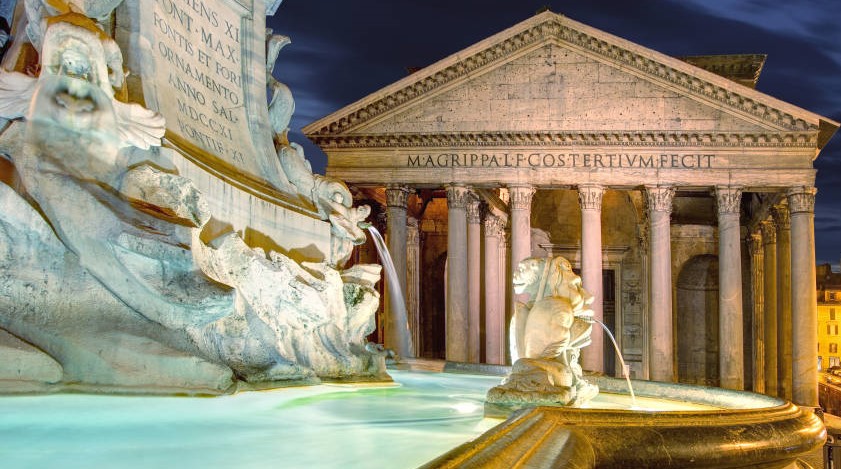
The Pantheon was built as a Roman temple and completed by the emperor Hadrian around 126 A.D. The name “Pantheon” comes from the Greek, meaning “honor all Gods” and this exactly was its purpose. As with most of the ancient monuments in Rome also the Pantheon has more than one story to tell. Most historians believe that Emperor Augustus’ right hand, Agrippa, built the first Pantheon in 27 BC, but the building burned down in the great fire of 80 AD and was rebuilt by Emperor Domitian. But again the temple was struck by lightning and burned down once more in 110 AD. The Pantheon as we know it today was finally built in 120 AD by Emperor Hadrian. In 609 A.D the Pantheon was transformed into a church which might be the reason that it was saved from being destroyed during the Middle Ages. And yes, there are Sunday Masses for everyone to join until today. Truly fascinating are the 16 massive Corinthian columns (12m/39 ft tall) at the entry and the giant dome with its hole in the top, also called “The eye of the Pantheon”, the largest unreinforced concrete dome in the world and considered a great architectural achievement. The first king of unified Italy, Vittorio Emmanuelle II is buried in the Pantheon and so is his son, King Umberto I as well as the famous Renaissance painter Raphael.
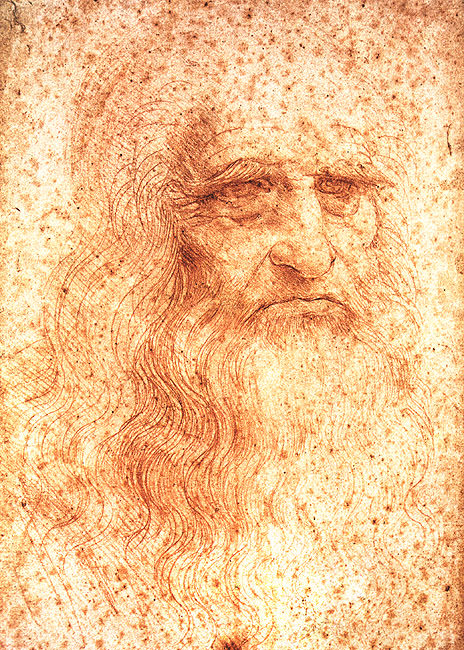
( This self portait was painted in 1512 using red chalk, when Leonardo da Vinci was 50 and living in France )
[ Biography ]
Leonardo was born on April 15, 1452, in the town of Vinci. His father was Ser Piero, a notary; his mother, Caterina, came of a peasant family. They were not married. The boy’s uncle Francesco may have had more of a hand in his upbringing than by either of his parents. When Leonardo was about 15, he moved to the nearby city of Florence and became an apprentice to the artist Andrea del Verrocchio. He was already a promising talent. While at the studio, he aided his master with his Baptism of Christ, and eventually painted his own Annunciation. Around the age of 30, Leonardo began his own practice, starting work on the Adoration of the Magi; however, he soon abandoned it and moved to Milan in 1482.
In Milan, Leonardo sought and gained the patronage of Ludovico Sforza, and soon began work on the painting Virgin of the Rocks. After some years, he began work on a giant bronze horse, a monument to Sforza’s father. Leonardo’s design is grand, but the statue was never completed. Meanwhile, he was keeping scrupulous notebooks on a number of studies, including artistic drawings but also depictions of scientific subjects ranging from anatomy to hydraulics. In 1490, he took a young boy, Salai, into his household, and in 1493 a woman named Caterina (most likely his mother) also came to live with him; she died a few years later. Around 1495, Leonardo began his painting The Last Supper, which achieved immense success but began to deteriorate physically almost immediately upon completion. Around this same time, Fra Luca Pacioli, the famous mathematician, moved to Milan, befriended Leonardo, and taught him higher math. In 1499, when the French conquered Lombard and Milan, the two left the city together, heading for Mantua.
In 1500, Leonardo arrived in Florence, where he painted the Virgin and Child with Saint Anne. He was very interested in mathematics at this time. In 1502, he went to work as chief military engineer to Cesare Borgia, and also became acquainted with Niccolo Machiavelli. After a year he returned to Florence, where he contributed to the huge engineering project of diverting the course of the River Arno, and also painted a giant war mural, the Battle of Anghiari, which was never completed, largely due to problems with the paints. In 1505 Leonardo probably made his first sketches for the Mona Lisa, but it is not known when he completed the painting.
In 1506, Leonardo traveled to Milan at the summons of Charles d’Amboise, the French governor. He became court painter and engineer to Louis XII and worked on a second version of the Virgin of the Rocks. In 1507, he returned to Florence to engage in a legal battle against his brothers for their uncle Francesco’s inheritance. In this same year, he took the young aristocratic Melzi as an assistant, and for the rest of the decade he intensified his studies of anatomy and hydraulics. In 1513, he moved to Rome, where Leo X reigned as pope. There, he worked on mirrors, and probably the above self- portrait. In 1516, he left Italy for France, joining King Francis I in Amboise, whom he served as a wise philosopher for three years before his death in 1519.
Napoleon Bonaparte, French emperor, was one of the greatest military leaders in history. He helped remake the map of Europe and established many government and legal reforms, but constant battles eventually led to his downfall.
Early years
Napoleon Bonaparte was born on August 15, 1769, in the Corsican city of Ajaccio. He was the fourth of eleven children of Carlo Buonaparte and Letizia Romolino. His father, a member of a noble Italian family, remained on good terms with the French when they took over control of Corsica.
Napoleon began his education at a boys’ school in Ajaccio. Then, at age ten, he was allowed to enter French military schools for aristocrats and was sent in 1779, with his older brother Joseph, to the College of Autun in Burgundy, France. Napoleon later transferred to the College of Brienne, another French military school. While at school in France, he was made fun of by the other students for his lower social standing and because he spoke Spanish and did not know French well. His small size earned him the nickname of the “Little Corporal.” Despite this teasing, Napoleon received an excellent education. When his father died, Napoleon led his household.
By 1785 Napoleon was a second lieutenant in the French army, but he often returned to Corsica. In 1792 he took part in a power struggle between forces supporting Pasquale Paoli (1725–1807), a leader in the fight for Corsican independence, and those supporting the French. After Paoli was victorious, he turned against Napoleon and the Bonaparte family, forcing them to flee back to France. Napoleon then turned his attention to a career in the army there. The French Revolution (1789–93), a movement to overthrow King Louis XVI (1754–1793) and establish a republic, had begun. Upon his return from Corsica in 1793, Napoleon made a name for himself and won a promotion by helping to defeat the British at Toulon and regain that territory for France.
Military successes
After being imprisoned for ten days on suspicion of treason and refusing assignment to lead the Army of the West, Napoleon was assigned to work for the map department of the French war office. His military career nearly ended, but when forces loyal to the king attempted to regain power in Paris in 1795, Napoleon was called in to stop the uprising. As a reward he was appointed commander of the Army of the Interior. Later that year Napoleon met Josephine de Beauharnais (1763–1814), and they were married in March 1796. Within a few days Napoleon left Josephine in Paris and started his new command of the Army of Italy. Soon the French troops were winning battle after battle against the Italians and Austrians. Napoleon advanced on Vienna, Austria, and engineered the signing of a treaty that gave France control of Italy.
Napoleon returned to Paris a hero, and he soon decided to invade Egypt. He sailed from Toulon, France, in May 1798 with an army of thirty-five thousand men. With only a few losses, all of lower Egypt came under Napoleon’s control. He set about reorganizing the government, the postal service, and the system for collecting taxes. He also helped build new hospitals for the poor. However, at this time a group of countries had banded together to oppose France. Austrian and Russian forces had regained control of almost all of Italy. Then, in August 1798, the British destroyed French ships in the Battle of the Nile, leaving the French army cut off from its homeland. Napoleon left the army under the command of General Jean Kléber and returned to France with a handful of officers.
Leadership of France
Landing at Fréjus, France, in October 1799, Napoleon went directly to Paris, where he helped overthrow the Directory, a five-man executive body that had replaced the king. Napoleon was named first consul, or head of the government, and he received almost unlimited powers. After Austria and England ignored his calls for peace, he led an army into Italy and defeated the Austrians in the Battle of Marengo (1800). This brought Italy back under French control. The Treaty of Amiens in March 1802 ended the war with England for the time being. Napoleon also restored harmony between the Roman Catholic Church and the French government. He improved conditions within France as well by, among other things, establishing the Bank of France, reorganizing education, and reforming France’s legal system with a new set of laws known as the Code Napoleon.
By 1802 the popular Napoleon was given the position of first consul for life, with the right to name his replacement. In 1804 he had his title changed to emperor. War resumed after a new coalition was formed against France. In 1805 the British destroyed French naval power in the Battle of Trafalgar. Napoleon, however, was able to defeat Russia and Austria in the Battle of Austerlitz. In 1806 Napoleon’s forces destroyed the Prussian army; after the Russians came to the aid of Prussia and were defeated themselves, Alexander I (1777–1825) of Russia made peace at Tilsit in June 1807. Napoleon was now free to reorganize western and central Europe as he pleased. After Sweden was defeated in 1808 with Russia’s help, only England remained to oppose Napoleon.
Napoleon was unable to invade England because of its superior naval forces. He decided to introduce the Continental System, a blockade designed to close all the ports of Europe to British trade. He hoped this would force the British to make peace on French terms. In Spain in 1808 the Peninsular War broke out over Spanish opposition to the placement of Napoleon’s brother Joseph on the throne. The English helped Spain in this battle, which kept French troops occupied until 1814. In addition, Alexander I’s decision to end Russia’s cooperation with the Continental System led Napoleon to launch an invasion of that country in 1812. Lack of supplies, cold weather, and disease led to the deaths of five hundred thousand of Napoleon’s troops.
Fall from glory
Napoleon had his marriage to Josephine dissolved and then, in March 1810, he married Marie Louise, the daughter of Emperor Francis II of Austria. Despite this union, Austria declared war on him in 1813. In March 1814 Paris fell to a coalition made up of Britain, Prussia, Sweden, and Austria. Napoleon stepped down in April. Louis XVIII (1755–1824), the brother of Louis XVI, was placed on the French throne. Napoleon was exiled to the island of Elba, but after ten months he made plans to return to power. He landed in southern France in February 1815 with 1,050 soldiers and marched to Paris, where he reinstated himself to power. Louis XVIII fled, and Napoleon’s new reign began. The other European powers gathered to oppose him, and Napoleon was forced to return to war.
The Battle of Waterloo was over within a week. On June 18, 1815, the combined British and Prussian armies defeated Napoleon. He returned to Paris and stepped down for a second time on June 22. He had held power for exactly one hundred days. Napoleon at first planned to go to America, but he surrendered to the British on July 3. He was sent into exile on the island of St. Helena in the South Atlantic Ocean. There he spent his remaining years until he died of cancer on May 5, 1821.


.jpg!Large.jpg)
 European Culture