
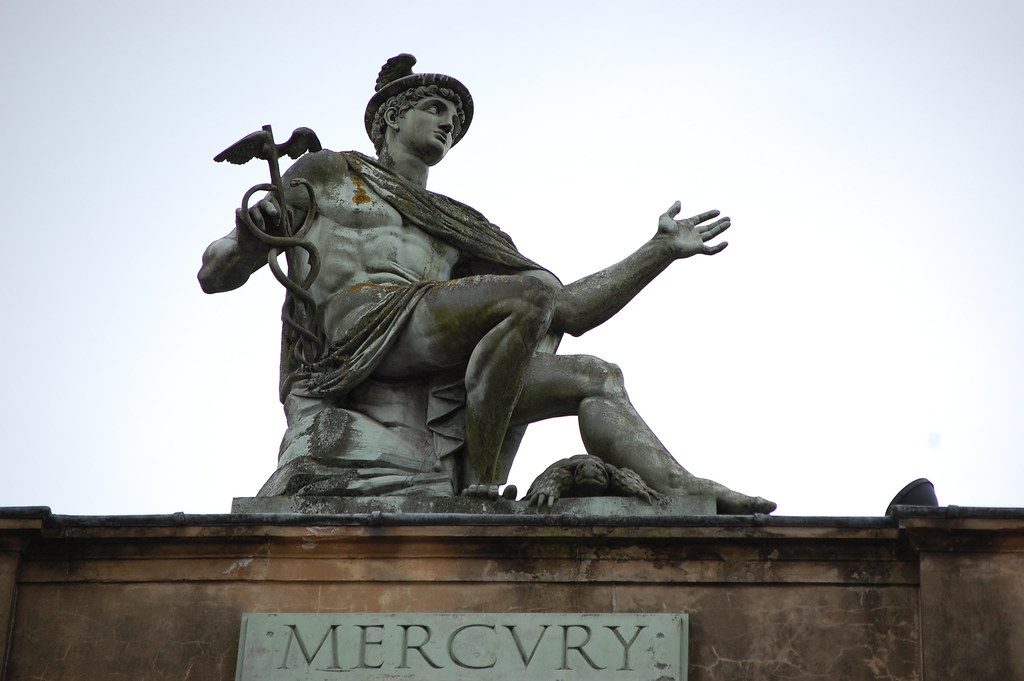
Statue of Mercury, who was the messenger of the Gods .
(On top of a building in the “Italian Centre” of Glasgow, Scotland)

Statue of Mercury, who was the messenger of the Gods .
(On top of a building in the “Italian Centre” of Glasgow, Scotland)
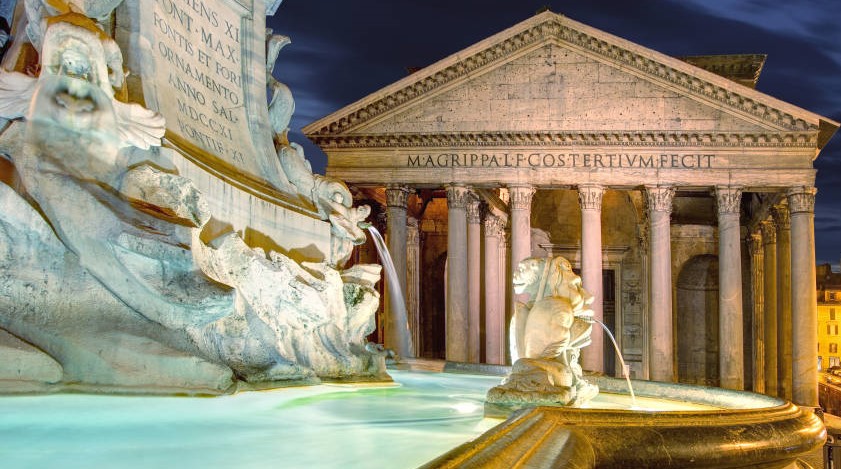
The Pantheon was built as a Roman temple and completed by the emperor Hadrian around 126 A.D. The name “Pantheon” comes from the Greek, meaning “honor all Gods” and this exactly was its purpose. As with most of the ancient monuments in Rome also the Pantheon has more than one story to tell. Most historians believe that Emperor Augustus’ right hand, Agrippa, built the first Pantheon in 27 BC, but the building burned down in the great fire of 80 AD and was rebuilt by Emperor Domitian. But again the temple was struck by lightning and burned down once more in 110 AD. The Pantheon as we know it today was finally built in 120 AD by Emperor Hadrian. In 609 A.D the Pantheon was transformed into a church which might be the reason that it was saved from being destroyed during the Middle Ages. And yes, there are Sunday Masses for everyone to join until today. Truly fascinating are the 16 massive Corinthian columns (12m/39 ft tall) at the entry and the giant dome with its hole in the top, also called “The eye of the Pantheon”, the largest unreinforced concrete dome in the world and considered a great architectural achievement. The first king of unified Italy, Vittorio Emmanuelle II is buried in the Pantheon and so is his son, King Umberto I as well as the famous Renaissance painter Raphael.
[SOURCE:www.wostphoto.com/rome-pantheon]

Title: Orpheus and Eurydice
Author: Michel Martin Drolling
Year: 1820
Orpheus was the son of Apollo and Calliope, the Muse. Apollo gave his son a lyre and taught him how to play; Orpheus did to such perfection that even Apollo was surprised. It is said that nothing could resist to his music and melody, neither friends nor enemies or beasts. Even trees and rocks were entranced with his music.
Orpheus fell in love with Eurydice a woman of unique beauty; they got married and lived happily for many years. Hymen was called to bless the marriage and he predicted that their perfection was not meant to last for years.
At some time, soon after his omen, Eurydice was wandering in the forest with the Nymphs, when Aristaeus, a shepherd saw her and was beguiled by her beauty. He started chasing her and making advances on her. Eurydice got scared and tried to escape, but she was bitten by a snake and died.
Orpheus sang his grief with his lyre and managed to move everything living or not on the world; both humans and Gods were deeply touched by his sorrow and grief.
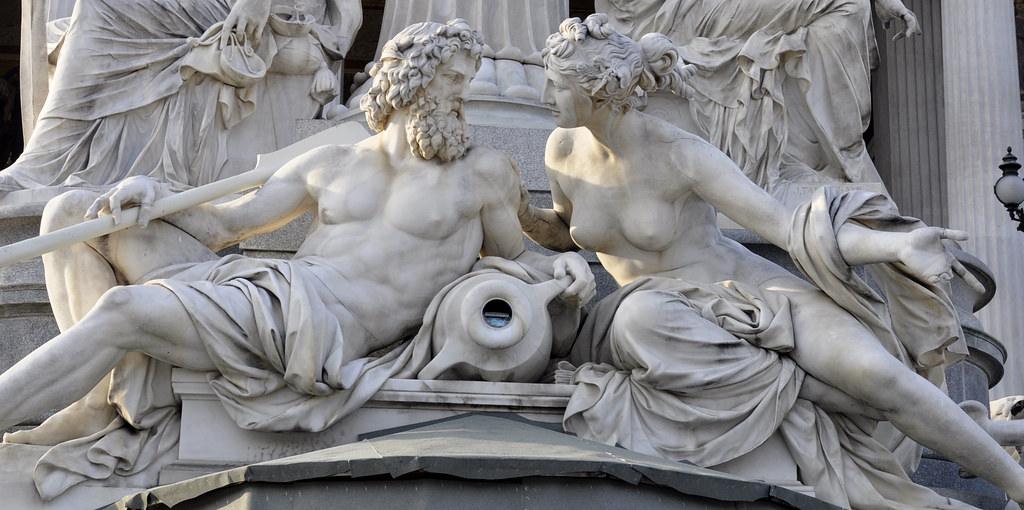
Zeus and Hera – Athena Fountain by Carl Kundmann, Josef Tautenhayn and Hugo Haerdtl. Austrian Parliament Building, Vienna.
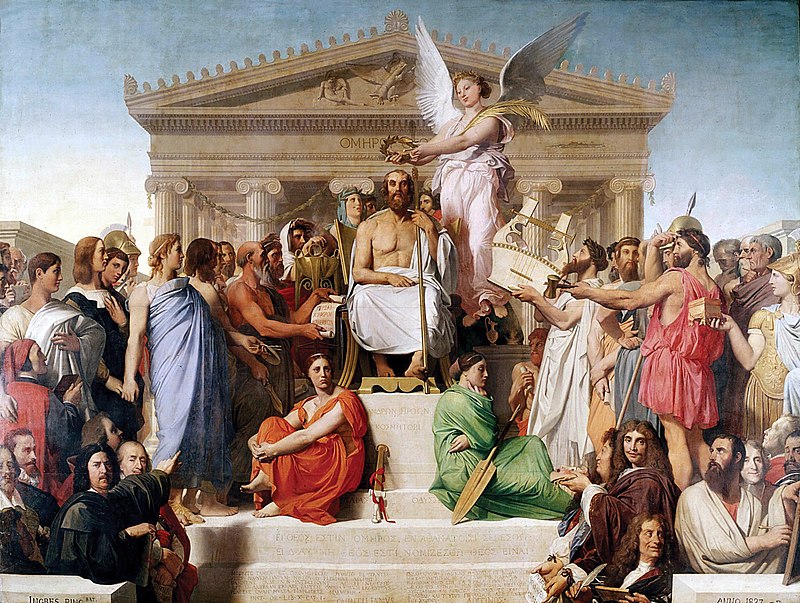
Title: The Apotheosis of Homer
Author: Jean Auguste Dominique Ingres
Year: 1827
Genre: mythological painting
Style: Neoclassicism
Media: oil, canvas
Location: Louvre, Paris, France
Ingres created this painting by combining over 100 small drawings for the assorted characters, each one making the drawing more detailed and precise. The painting was a state commission by Charles X to have himself remembered in the building works of the Louvre. The painting depicts an image of Homer, receiving all of the brilliant men of Rome, Greece, and contemporary times. The characters in the painting were extensively researched by Ingres, who studied the paintings of Nicholas Poussin, Raphael, and Apelles, the ancient Greek painter. The painting also includes the figures of Dante, Virgil, and Moliere, the French playwright, along with other figures, including Greek and Roman Gods.
[ SOURCE: Wikiart.org ]
 European Culture