” The Entrance to the Grand Canal, Venice by Canaletto / Year: 1730 ”

The Entrance to the Grand Canal, Venice by Canaletto

“The Entrance to the Grand Canal, Venice” by Canaletto portrays the Rococo landscape of the entrance to the Grand Canal, Venice. The composition is a veduta, a word derived from the Italian for “view”, which means a highly detailed, large-scale painting of a cityscape or some other vista.

This Canaletto is a typical example of the ‘vedute paintings’ popular with Grand Tour travellers of the 1700s as a visual record of their travels. Canaletto was one of the more famous painters of city views or vedute, especially of Venice. From 1746 to 1756 he worked in England where he created many paintings of the sights of London. He was highly successful in England and became famous thanks to the British merchant and connoisseur Joseph Smith who sold his large collection of Canaletto’s paintings to King George III in 1762. Canaletto’s paintings became highly prized as during the 18th century European monarchs vied for his grandest pictures.

Many of Canaletto’s paintings can be found in museums across the world, depict highly detailed, usually large-scale paintings of Venetian other famous cityscapes or vistas.
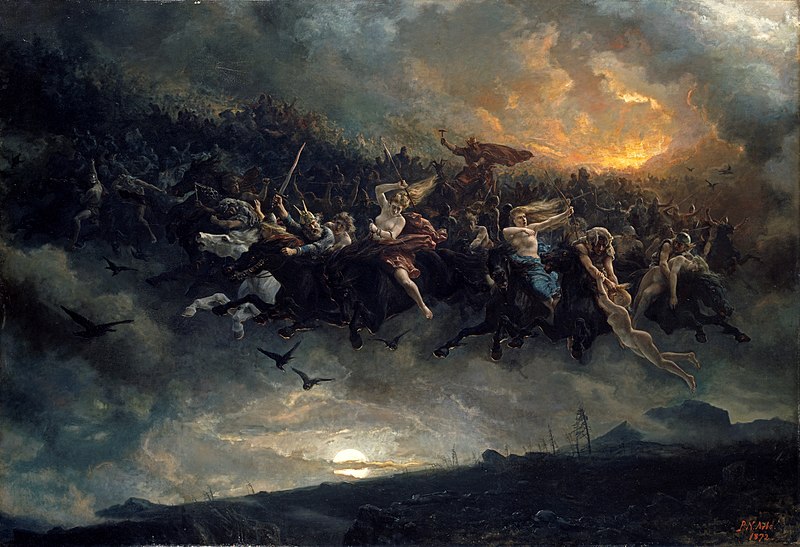
” The wild Hunt of Odin ”

year 1872 / by Peter Nicolai Arbo

The painting is based on the Wild Huntmotif from folklore and Norse mythology. In the Scandinavian tradition, the Wild Hunt is often associated with the god Odin who leads a terrifying procession of gods, trolls and restless souls that hurl across the sky during midwinter and abduct unfortunate people who have failed to find a hiding place

” The Starry Night ”

”The Starry Night”

by Vincent van Gogh

Date Created 1889 /Saint-Rémy-de-Provence

Vincent van Gogh painted Starry Night in 1889 during his stay at the asylum of Saint-Paul-de-Mausole near Saint-Rémy-de-Provence. Van Gogh lived well in the hospital; he was allowed more freedoms than any of the other patients. If attended, he could leave the hospital grounds; he was allowed to paint, read, and withdraw into his own room. He was even given a studio. While he suffered from the occasional relapse into paranoia and fits – officially he had been diagnosed with epileptic fits – it seemed his mental health was recovering.
Unfortunately, he relapsed. He began to suffer hallucination and have thoughts of suicide as he plunged into depression. Accordingly, there was a tonal shift in his work. He returned to incorporating the darker colors from the beginning of his career and Starry Night is a wonderful example of that shift. Blue dominates the painting, blending hills into the sky. The little village lays at the base in the painting in browns, greys, and blues. Even though each building is clearly outlined in black, the yellow and white of the stars and the moon stand out against the sky, drawing the eyes to the sky. They are the big attention grabber of the painting.

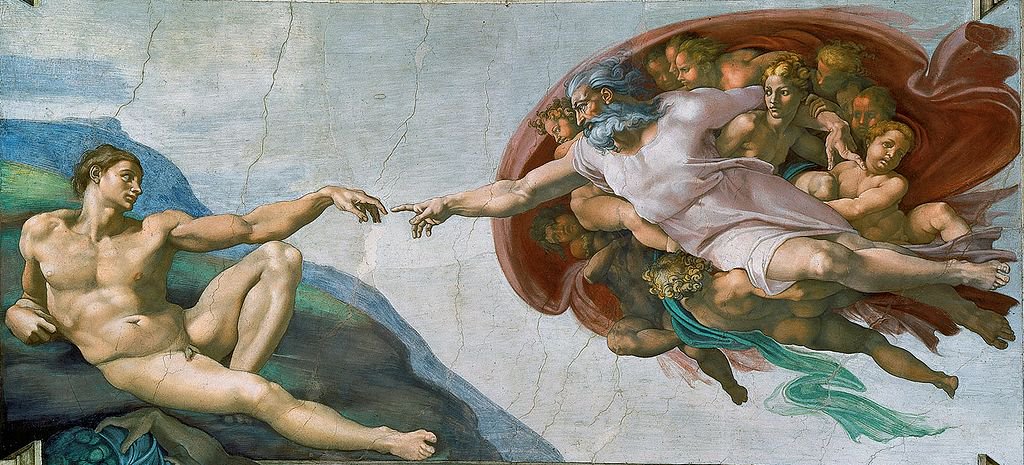
” Creation of Adam ” by Michelangelo

The panel of The Creation of Adam in the Sistine Chapel must be one of the most known images in the world.
Completed by Michelangelo circa 1511, it depicts God the father creating Adam, the first man and was amongst the last panels to be completed, telling the story of Genesis. The focal point of the episode of the Creation of Adam painting is the contact between the fingers of God and those of Adam, through which the breath of life is transmitted. By not painting the fingers of God and Adam touching and leaving a small space between the two, Michelangelo creates a tingling tension, an anticipation of that wonderous moment, as we all wait for God to complete his Creation of Adam.

Michelangelo’s languid Adam was probably inspired by Ghiberti’s Adam on his Doors of Paradise of the baptistery in Florence. Whereas in his, The Creation of Eve, Michelangelo borrows heavily from Jacopo della Quercia’s version on the portal of San Petronio in Bologna. In the Eve panel Michelangelo did not use foreshortening, making the figures difficult to see clearly from the floor of the chapel. In the Creation of Adam, the great artist addresses this problem, with an obvious focus on the enlarged figures of God and Adam.

The painting of Michelangelo’s Creation of Adam only took two to three weeks to complete, while the actual painting of Adam took Michelangelo only four days! An admiring Vasari (1511 – 1574) gasped with amazement and said, “a figure of such a kind in its beauty, in the attitude and in the outlines, that it appears as if newly fashioned by the first and supreme Creator rather than by the brush and design of mortal man.” Today we see the Creation of Adam as a masterpiece within a masterpiece.