

Title: Pollice Verso (Thumbs Down)
Author: Jean-Léon Gérôme
Year: 1872
Medium: oil on canvas
Location: Phoenix Art Museum

Title: Pollice Verso (Thumbs Down)
Author: Jean-Léon Gérôme
Year: 1872
Medium: oil on canvas
Location: Phoenix Art Museum
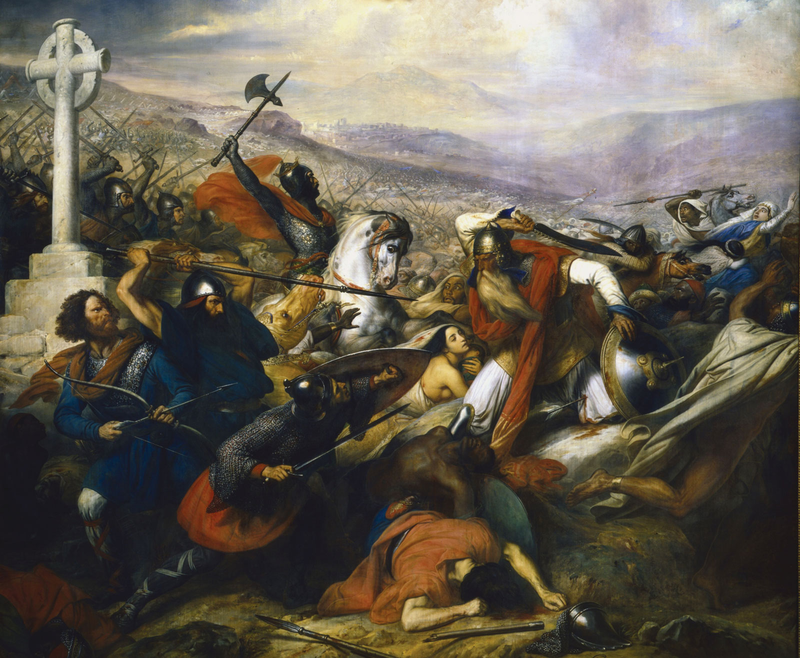
Title: Battle of Tours
Author: Charles de Steuben
Year: 1837
Medium: oil on canvas
Museum: Chateau de Versailles – France
The Battle of Tours was fought on October 10, 732 between forces under the Frankish leader Charles Martel and a massive invading Islamic army led by Emir Abdul Rahman Al Ghafiqi Abd al Rahman, near the city of Tours, France. During the battle, the Franks defeated the Islamic army and Emir Abd er Rahman was killed. This battle stopped the northward advance of Islam from the Iberian peninsula, and is considered by most historians to be of macrohistorical importance, in that it halted the Islamic conquests, and preserved Christianity as the controlling faith in Europe, during a period in which Islam was overrunning the remains of the old Roman and Persian Empires.

Title: God Speed
Author: Edmund Leighton
Year: 1900
Genre: History painting
Medium: oil on canvas
Edmund Leighton made several paintings on the subject of chivalry. God Speed was one of the earliest paintings on the series and up to this day is considered as one of Leighton’s most recognizable works. It captures love during the Medieval period, depicting a knight off to battle, leaving his beloved woman behind. The woman wishes him luck by tying a sash around his arm, a custom during those times, as a sign that they will remain united and will be reunited, a symbol of hope that all will turn out well.

Title: The Romans in their Decadence
Author: Thomas Couture
Year: 1847
Medium: oil paint
Location: Musée d’Orsay, Paris
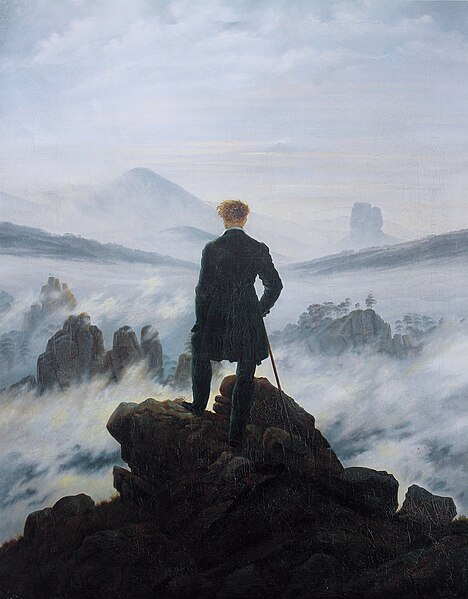
Title: The wanderer above the sea of fog
Artist: Caspar David Friedrich
Year: 1817
Medium: oil on canvas
Wanderer above the Sea of Fog (Der Wanderer über dem Nebelmeer), also known as Wanderer above the Mist or Mountaineer in a Misty Landscape, is an oil painting c. 1818 by the German Romantic artist Caspar David Friedrich. It has been considered one of the masterpieces of Romanticism and one of its most representative works. It currently resides in the Kunsthalle Hamburg in Hamburg, Germany.
In the foreground, a young man stands upon a rocky precipice with his back to the viewer. He is wrapped in a dark green overcoat, and grips a walking stick in his right hand. His hair caught in a wind, the wanderer gazes out on a landscape covered in a thick sea of fog. In the middle ground, several other ridges, perhaps not unlike the ones the wanderer himself stands upon, jut out from the mass. Through the wreaths of fog, forests of trees can be perceived atop these escarpments. In the far distance, faded mountains rise in the left, gently leveling off into lowland plains in the east. Beyond here, the pervading fog stretches out indefinitely, eventually commingling with the horizon and becoming indistinguishable from the cloud-filled sky.
Friedrich’s canvases are intended to promote a meditative state, arising out of the vision and spirit of the artist and communicated to the viewer as an object for contemplation. “The artist,” he wrote, “should not only paint what he sees before him, but also what he sees within him.” Thus he gave these directions to would-be artists, “Close your bodily eye so that you see your picture first with your spiritual eye. Then bring what you saw in the dark into the light, so that it may have an effect on others, shining inwards from outside.
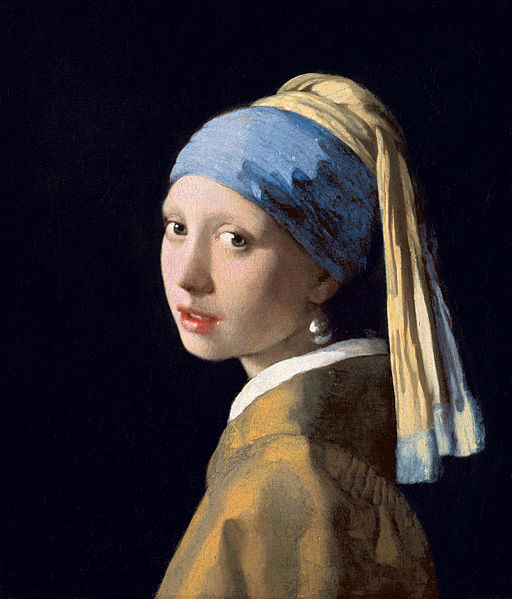
Title: Girl with a Pearl Earring
Artist: Johannes Vermeer Genre tronie
Date: circa 1665
Medium: oil on canvas

Artist: Leonardo da Vinci
Year: c. 1490
Type: Pen and ink with wash over metalpoint on paper
Location: Gallerie dell’Accademia, Venice
The Vitruvian Man, Italian: Le proporzioni del corpo umano secondo Vitruvio, is a drawing by Leonardo da Vinci around 1490. It is accompanied by notes based on the work of the architect Vitruvius. The drawing, which is in pen and ink on paper, depicts a man in two superimposed positions with his arms and legs apart and inscribed in a circle and square. The drawing and text are sometimes called the Canon of Proportions or, less often, Proportions of Man. It is kept in the Gabinetto dei disegni e stampe of the Gallerie dell’Accademia, in Venice, Italy, under reference 228. Like most works on paper, it is displayed to the public only occasionally. The drawing is based on the correlations of ideal human proportions with geometry described by the ancient Roman architect Vitruvius in Book III of his treatise De Architectura. Vitruvius described the human figure as being the principal source of proportion among the Classical orders of architecture. Vitruvius determined that the ideal body should be eight heads high. Leonardo’s drawing is traditionally named in honor of the architect.
.jpg)
Author: Edvard Munch
Date: 1906
Style: Expressionism
Genre: portrait
Media: oil, canvas
FRIEDRICH NIETZSCHE SHORT BIOGRAPHY
1844-1900
Friedrich Nietzsche was born in Rocken, Saxony (the present-day Germany) on Oct. 15, 1844. He came from a line of Protestant churchman – his father and grandfathers were Lutherman ministers. He studied Classical literature and language at the universities in Bonn and Leipzig. At the age of 24, Nietzsche became a professor at the University of Basel in Switzerland.
After reading the works of the German philosopher Schopenhauer, Nietzsche became a philosopher and began living a life of solitude. He agreed with Schopenhauer that there is no God and life is filled with pain and suffering, but Nietzsche came to his own conclusion that humans must get everything out of life and set out to find out how to best do that.
Nietzsche was totally against religion, in particular Christianity.
Nietzsche proclaimed that “God is dead” in his most famous work, “Thus Spake Zarathustra,” (1883-1892) saying that most people do not believe in God and religion is no longer the foundation for morals. “Thus Spake Zarathustra” was not successful when it was first published, but is now considered a masterpiece in world literature. In 1896, the composer Richard Strauss composed a tone-poem called “Also Sprach Zarathustra” based on Nietzsche’s words.Nietzsche’s works “Beyond Good and Evil” (1886) and “The Genealogy of Morals” (1887) dealt with the origins of moral values. Nietzsche believed that in early civilization the theory of perpetual elimination of the weak by the strong and the incompetent by the competent was correct. But then the Judeo-Christian religion disagreed and said that thought was wrong and the weak and meek shall inherit the earth. What happened was the geniuses, innovators and creators were made equal to the common masses. Nietzsche believed that Christianity’s emphasis on the afterlife make humans less capable of handling life right now.
Nietzsche believed that religious “morality” killed the genius of innovation and could end culture and civilization. Since there is no God, there must be HUMAN creations and realizations. Humans have the “will to power” in politics, culture and everywhere. Nietzsche’s ideal was the super-human-being or the “OVERMAN” or “SUPERMAN”, which is a superior individual who controls his/her passions and uses them in a creative way. The SUPERMAN’S will to power would set him/her apart from the herd of inferior masses. Nietzsche was famous for his much quoted line “What doesn’t kill us makes us stronger.”
In 1889, Nietzsche tragically suffered a nervous breakdown and was overcome by mental illness in his mid forties, allegedly brought on by tertiary syphilis. The actual breakdown started in Turin, where Nietzsche collapsed with his arms around the neck of a horse that was being whipped by a coachman. He became hopelessly insane and on August 25, 1900 at the age 56, Nietzsche died.

Title: Hylas and the Nymphs
Artist: John William Waterhouse
Year: 1896
Type: Oil on canvas
Hylas and the Nymph is an oil on canvas painting undertaken by Baron François Gérard in about 1826 showing a story from Greek mythology.
The painting Hylas and the Nymph depicts the moment when the Greek hero Hylas is abducted by a Naiad Nymph.
Hylas was an Argonaut, who had joined the crew of the Argo alongside his friend Heracles. When the Argo stopped for water in Mysia, the Naiad fell in love with the beautiful Hylas. Heracles would be abandoned by Jason when he stopped to look for his companion, but Hylas was never found by Heracles.
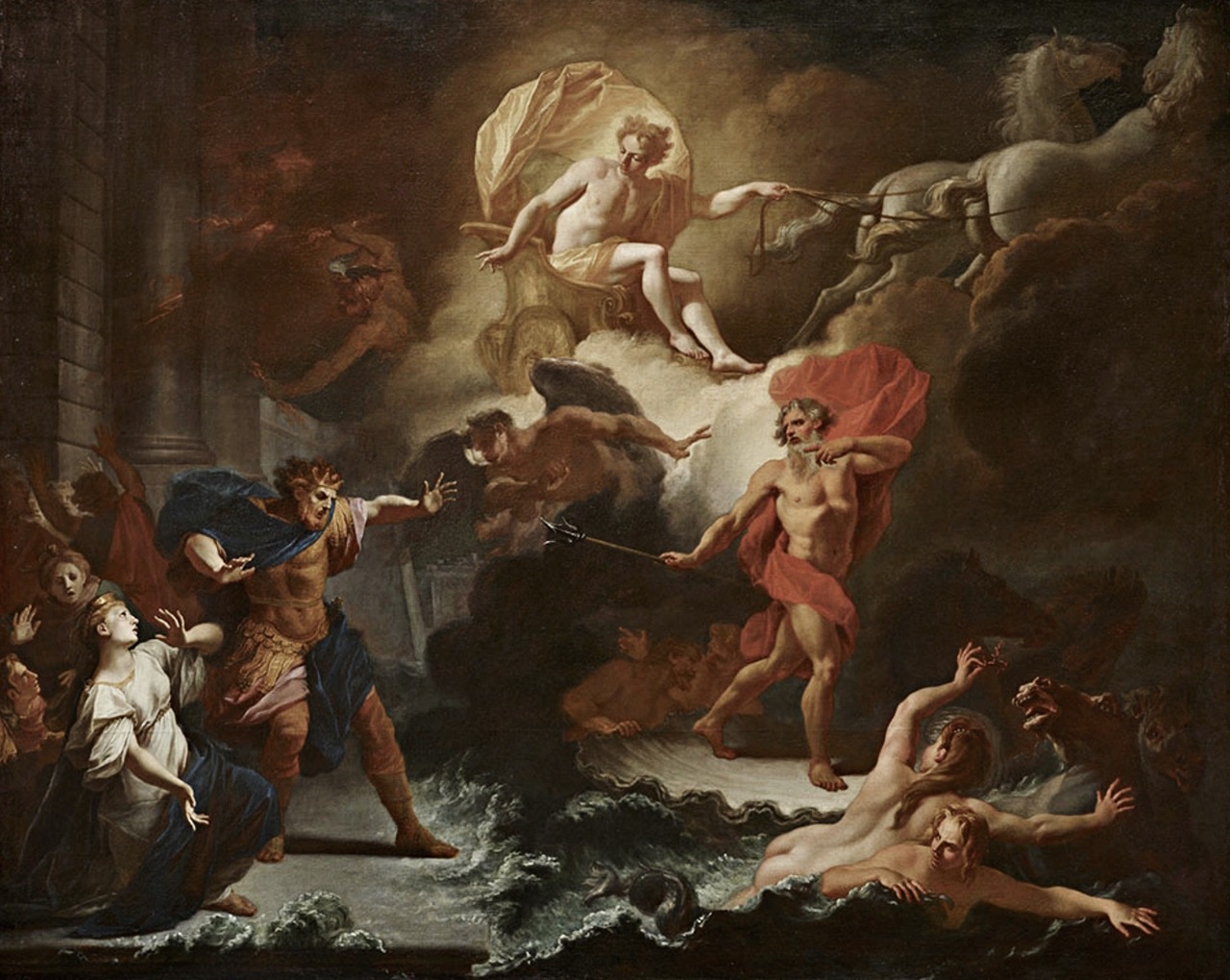
title : Laomendon Punished by Neptune and Apollo
author : Pierre Dulin
year : 1707
type : oil,canvas
 European Culture