

Title: Romulus and Remus
Author: Peter Paul Rubens
Year: 1615
Genre: mythological painting
Medium: oil on canvas
Location: Capitoline Museums – Rome , Italy

Title: Romulus and Remus
Author: Peter Paul Rubens
Year: 1615
Genre: mythological painting
Medium: oil on canvas
Location: Capitoline Museums – Rome , Italy

Title: The artist dreaming in his workshop
Author: Emile-Louis Foubert
Medium: oil on canvas
Year: 1886
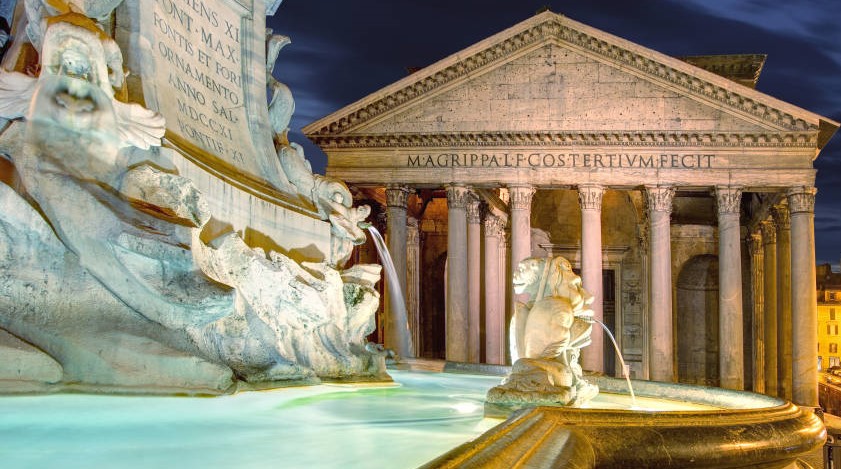
The Pantheon was built as a Roman temple and completed by the emperor Hadrian around 126 A.D. The name “Pantheon” comes from the Greek, meaning “honor all Gods” and this exactly was its purpose. As with most of the ancient monuments in Rome also the Pantheon has more than one story to tell. Most historians believe that Emperor Augustus’ right hand, Agrippa, built the first Pantheon in 27 BC, but the building burned down in the great fire of 80 AD and was rebuilt by Emperor Domitian. But again the temple was struck by lightning and burned down once more in 110 AD. The Pantheon as we know it today was finally built in 120 AD by Emperor Hadrian. In 609 A.D the Pantheon was transformed into a church which might be the reason that it was saved from being destroyed during the Middle Ages. And yes, there are Sunday Masses for everyone to join until today. Truly fascinating are the 16 massive Corinthian columns (12m/39 ft tall) at the entry and the giant dome with its hole in the top, also called “The eye of the Pantheon”, the largest unreinforced concrete dome in the world and considered a great architectural achievement. The first king of unified Italy, Vittorio Emmanuelle II is buried in the Pantheon and so is his son, King Umberto I as well as the famous Renaissance painter Raphael.
[SOURCE:www.wostphoto.com/rome-pantheon]

Title: Hercules Removes Cerberus from the Gates of Hell
Author: Johann Köler
Year: 1855
Medium: oil on canvas
Location: Art Museum of Estonia
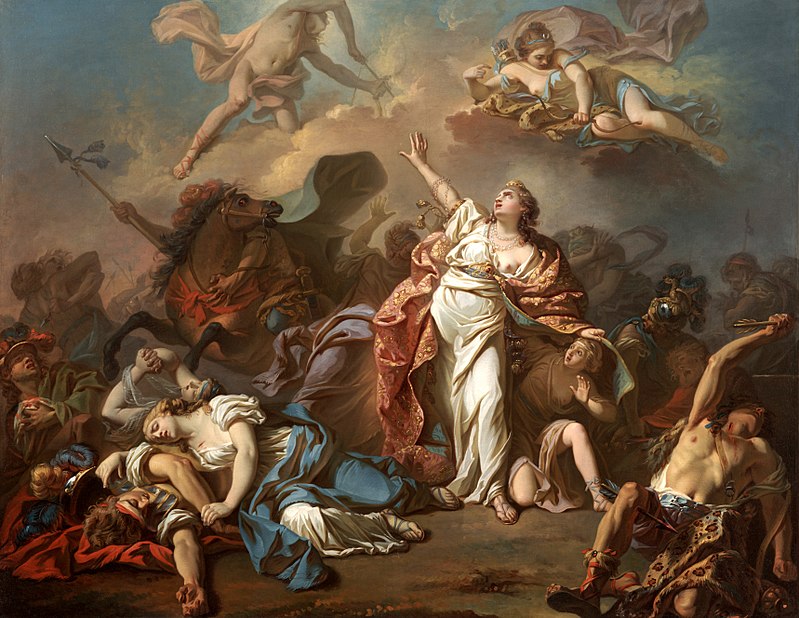
Title: Diana and Apollo Killing Niobe’s Children
Author: Jacques-Louis David
Year: 1772
Style: Neoclassicism
Media: oil, canvas
Location: Dallas Museum of Art

Title: Archduke Leopold Wilhelm and the artist in the archducal picture gallery in Brussels
Author: David Teniers the Younger
Year: 1653
Genre: interior view
Medium: oil on canvas
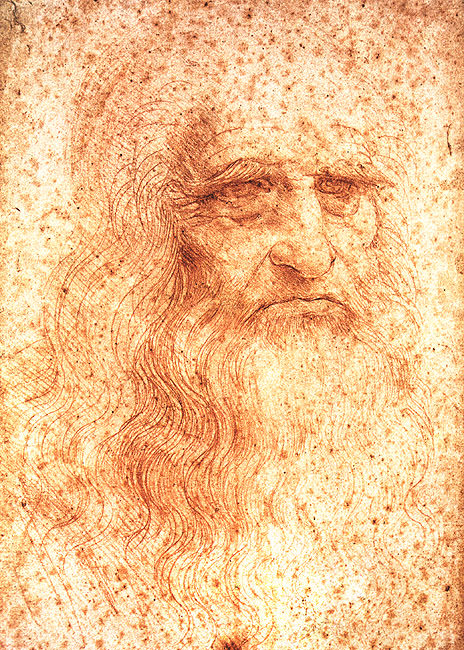
( This self portait was painted in 1512 using red chalk, when Leonardo da Vinci was 50 and living in France )
[ Biography ]
Leonardo was born on April 15, 1452, in the town of Vinci. His father was Ser Piero, a notary; his mother, Caterina, came of a peasant family. They were not married. The boy’s uncle Francesco may have had more of a hand in his upbringing than by either of his parents. When Leonardo was about 15, he moved to the nearby city of Florence and became an apprentice to the artist Andrea del Verrocchio. He was already a promising talent. While at the studio, he aided his master with his Baptism of Christ, and eventually painted his own Annunciation. Around the age of 30, Leonardo began his own practice, starting work on the Adoration of the Magi; however, he soon abandoned it and moved to Milan in 1482.
In Milan, Leonardo sought and gained the patronage of Ludovico Sforza, and soon began work on the painting Virgin of the Rocks. After some years, he began work on a giant bronze horse, a monument to Sforza’s father. Leonardo’s design is grand, but the statue was never completed. Meanwhile, he was keeping scrupulous notebooks on a number of studies, including artistic drawings but also depictions of scientific subjects ranging from anatomy to hydraulics. In 1490, he took a young boy, Salai, into his household, and in 1493 a woman named Caterina (most likely his mother) also came to live with him; she died a few years later. Around 1495, Leonardo began his painting The Last Supper, which achieved immense success but began to deteriorate physically almost immediately upon completion. Around this same time, Fra Luca Pacioli, the famous mathematician, moved to Milan, befriended Leonardo, and taught him higher math. In 1499, when the French conquered Lombard and Milan, the two left the city together, heading for Mantua.
In 1500, Leonardo arrived in Florence, where he painted the Virgin and Child with Saint Anne. He was very interested in mathematics at this time. In 1502, he went to work as chief military engineer to Cesare Borgia, and also became acquainted with Niccolo Machiavelli. After a year he returned to Florence, where he contributed to the huge engineering project of diverting the course of the River Arno, and also painted a giant war mural, the Battle of Anghiari, which was never completed, largely due to problems with the paints. In 1505 Leonardo probably made his first sketches for the Mona Lisa, but it is not known when he completed the painting.
In 1506, Leonardo traveled to Milan at the summons of Charles d’Amboise, the French governor. He became court painter and engineer to Louis XII and worked on a second version of the Virgin of the Rocks. In 1507, he returned to Florence to engage in a legal battle against his brothers for their uncle Francesco’s inheritance. In this same year, he took the young aristocratic Melzi as an assistant, and for the rest of the decade he intensified his studies of anatomy and hydraulics. In 1513, he moved to Rome, where Leo X reigned as pope. There, he worked on mirrors, and probably the above self- portrait. In 1516, he left Italy for France, joining King Francis I in Amboise, whom he served as a wise philosopher for three years before his death in 1519.
[SOURCE: sparknotes.com]

Title: Pallas and Centaur
Author: Sandro Botticelli
Year: 1482
Style: Renaissance
Genre: mythological painting
Location: Uffizi Gallery, Florence, Italy

Title: Medusa
Author: Caravaggio
Year: 1597
Style: Baroque
Genre: mythological painting
Media: oil, canvas
Location: Uffizi Gallery, Florence, Italy
Medusa was a Gorgon monster, a terrifying female creature from the Greek Mythology. While descriptions of Gorgons vary across Greek literature, the term commonly refers to any of three sisters who had hair of living, venomous snakes, and a horrifying visage that turned those who beheld it to stone. Traditionally, while two of the Gorgons were immortal, Stheno and Euryale , their sister Medusa was not, and was slain by the mythical hero Perseus, the legendary founder of Mycenae and of the Perseid dynasty. According to the story, she was killed by Perseus, who avoided direct eye contact by using a mirrored shield. After Medusa’s death, her decapitated head continued to petrify those that looked at it.
[SOURCE:wikiart.org]
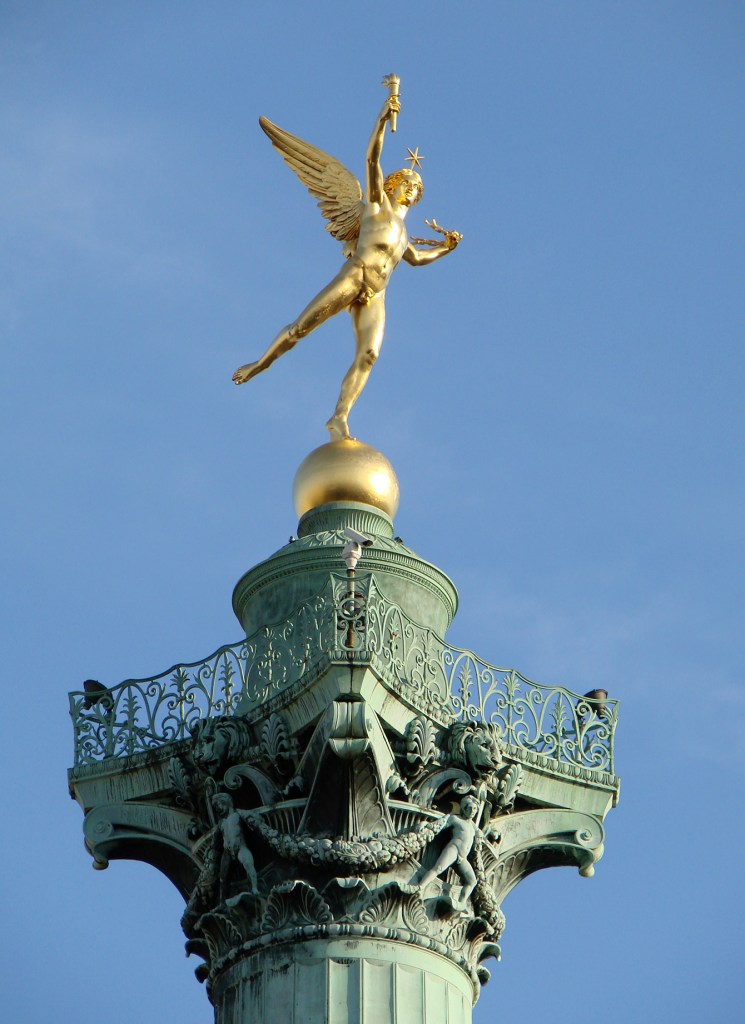
July Column designed by Jean-Antoine Alavoine .
Year: 1840
Location: Place de la Bastille, Paris , France
 European Culture