

Title: The Romans in their Decadence
Author: Thomas Couture
Year: 1847
Medium: oil paint
Location: Musée d’Orsay, Paris

Title: The Romans in their Decadence
Author: Thomas Couture
Year: 1847
Medium: oil paint
Location: Musée d’Orsay, Paris
:max_bytes(150000):strip_icc():format(webp)/the-statue-of-goddess-athena-in-front-of-the-austrian-parliament-in-vienna--856149104-5c7bee33c9e77c0001fd59ff.jpg)
Athena, also referred to as Athene, is a very important goddess of many things. She is goddess of wisdom, courage, inspiration, civilization, law and justice, strategic warfare, mathematics, strength, strategy, the arts, crafts, and skill. Her parents were Zeus, the king of the gods, and Metis, who was a Titan. Her symbols include armor, olive trees, snakes, and owls. She is normally depicted either dressed in full armor or in a long gown. She is known most specifically for her strategic skill in warfare and is often portrayed as companion of heroes and is the patron goddess of heroic endeavour.
Athena was worshipped throughout Ancient Greece. She was the patron goddess of several places, including Athens. In fact, Athens is the site of her most famous temple, the Parthenon, which is still standing today.
She is often depicted as leading soldiers into battle, something that caused her to be worshipped all over. She was the patron goddess of many popular heroes such as Odysseus, Jason, and Hercules.
Note that even though she is associated with war, she was very reluctant to use violence to solve conflict. As an intellectual, she preferred to use her wisdom to avoid conflict. If she did have to fight, she did so with a sense of purpose and effectiveness.
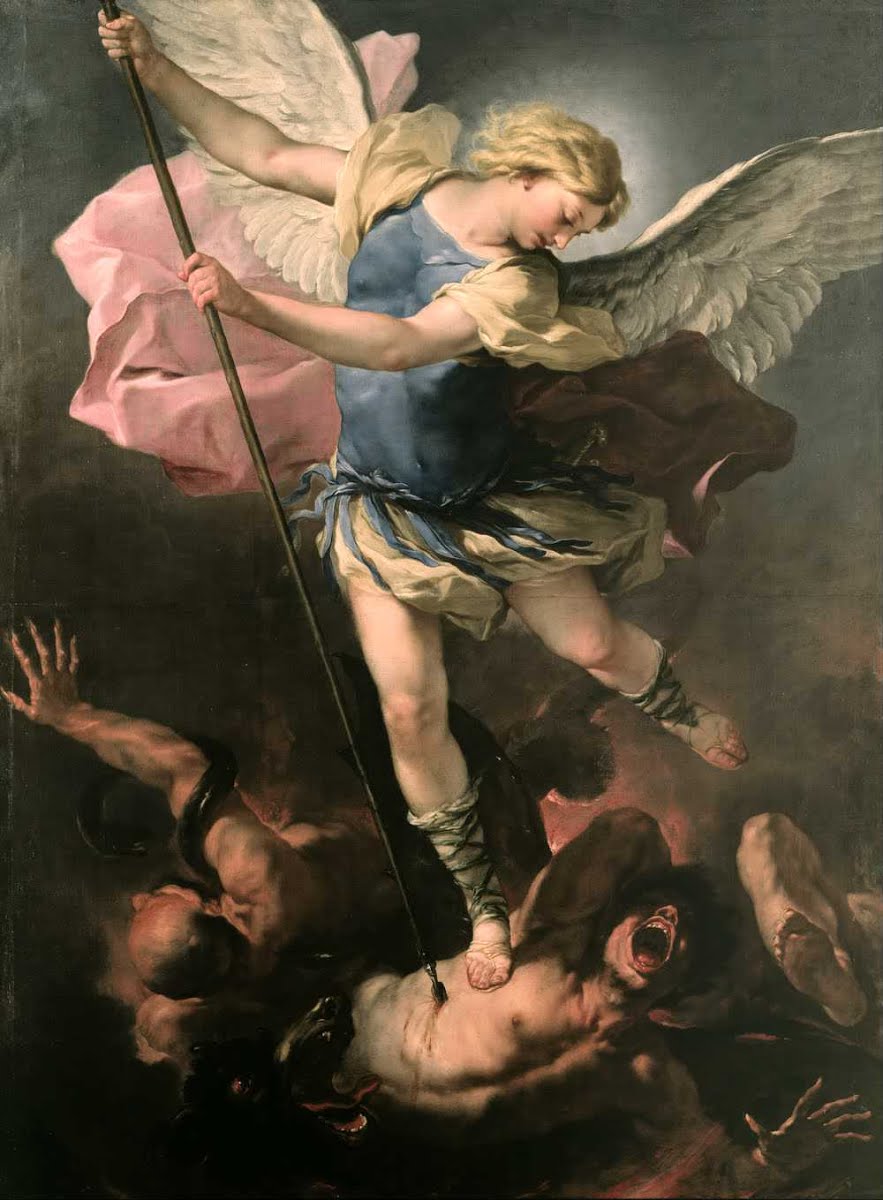
Title: St. Michael
Artist: Luca Giordano
Year: 1663
Genre: religious art
Period: Baroque
Dimensions: 198 cm × 147 cm (78 in × 58 in)
Medium: Oil on canvas
The story of the Archangel Michael’s victory over Satan and the renegade angels is told in Revelation (12, 7-9). As a Christian knight, St. Michael was perceived as a symbol of the Catholic Church victorious over Protestantism and the Turkish threat.
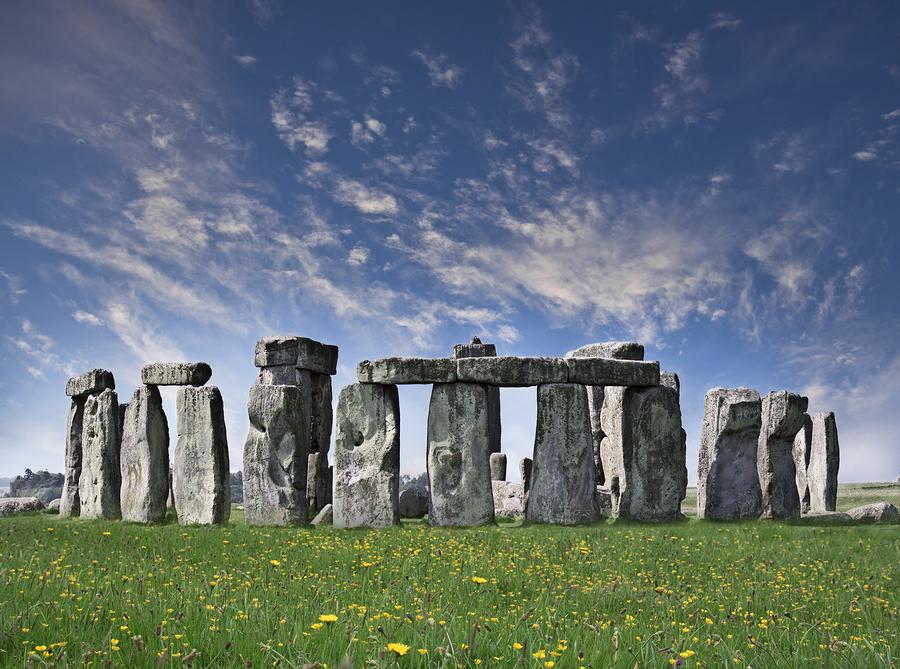
Stonehenge is a world-famous stone monument located near the town of Salisbury in Wiltshire County, England. Dating back approximately 3,500 years, these prehistoric statues are one of the most famous and mysterious attractions in the entire world. One of the most popular tourist attractions anywhere on earth, Stonehenge was reportedly built in three stages that totalled more than 30 million hours of work.
Although there are no written records on the construction of or motivation behind the creation of Stonehenge, speculation on the origins and purposes of these rock formations has continued for centuries. One school of thought is that it is a place of death, while others believe it has healing powers. Some theorise its purpose as one of human sacrifice while others surmise it has something to do with astronomy. Further still, many think of it as a place of worship while another widely held belief is that it acted as a solar calendar that was able to predict the sunrise, sunset, eclipse and moon activity.
Despite all the conjecture, Stonehenge continues to remain a mystery and a famous landmark to this day. With little information on how exactly these standing stones were placed there, the circular monument is said to date back as early as 3100 BC. Although the structure wasn’t complete at this time, work on the three phases of building had started and 1500 years later was finally complete. However there is evidence at the site that suggests the structure could date back as far as 6500 years.
Just how Stonehenge was built is equally mysterious with some believing supernatural forces must have contributed to the construction. With the stones being impossibly heavy, it’s hard to see how anyone could carry of move them into place. Archeologists have flocked to the site for centuries, trying to shed some light on how this amazing attraction came into being however the origins of Stonehenge continue to remain a mystery.
A must see on any visit to England, millions of tourists journey from all over the world to take in this mysterious yet mind-blowingly impressive wonder of the world. Depending on the time of day of your visit, you’ll notice the colours of the sarsen and bluestones and you are welcome to walk around the circle and lay on the green land to take in this amazing monument from every angle.
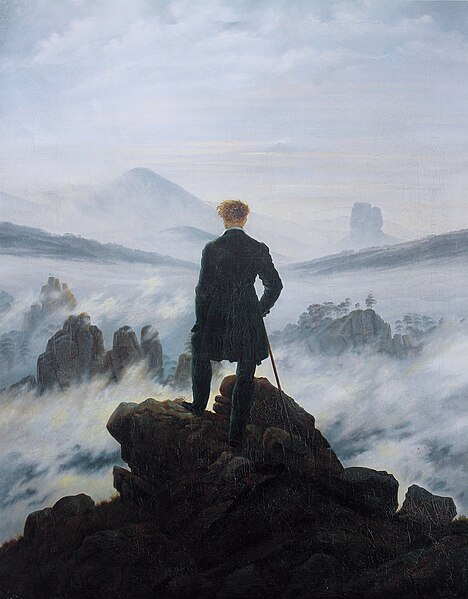
Title: The wanderer above the sea of fog
Artist: Caspar David Friedrich
Year: 1817
Medium: oil on canvas
Wanderer above the Sea of Fog (Der Wanderer über dem Nebelmeer), also known as Wanderer above the Mist or Mountaineer in a Misty Landscape, is an oil painting c. 1818 by the German Romantic artist Caspar David Friedrich. It has been considered one of the masterpieces of Romanticism and one of its most representative works. It currently resides in the Kunsthalle Hamburg in Hamburg, Germany.
In the foreground, a young man stands upon a rocky precipice with his back to the viewer. He is wrapped in a dark green overcoat, and grips a walking stick in his right hand. His hair caught in a wind, the wanderer gazes out on a landscape covered in a thick sea of fog. In the middle ground, several other ridges, perhaps not unlike the ones the wanderer himself stands upon, jut out from the mass. Through the wreaths of fog, forests of trees can be perceived atop these escarpments. In the far distance, faded mountains rise in the left, gently leveling off into lowland plains in the east. Beyond here, the pervading fog stretches out indefinitely, eventually commingling with the horizon and becoming indistinguishable from the cloud-filled sky.
Friedrich’s canvases are intended to promote a meditative state, arising out of the vision and spirit of the artist and communicated to the viewer as an object for contemplation. “The artist,” he wrote, “should not only paint what he sees before him, but also what he sees within him.” Thus he gave these directions to would-be artists, “Close your bodily eye so that you see your picture first with your spiritual eye. Then bring what you saw in the dark into the light, so that it may have an effect on others, shining inwards from outside.
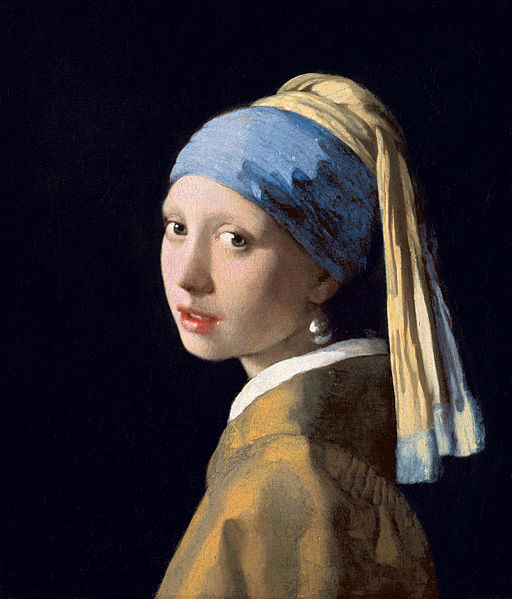
Title: Girl with a Pearl Earring
Artist: Johannes Vermeer Genre tronie
Date: circa 1665
Medium: oil on canvas
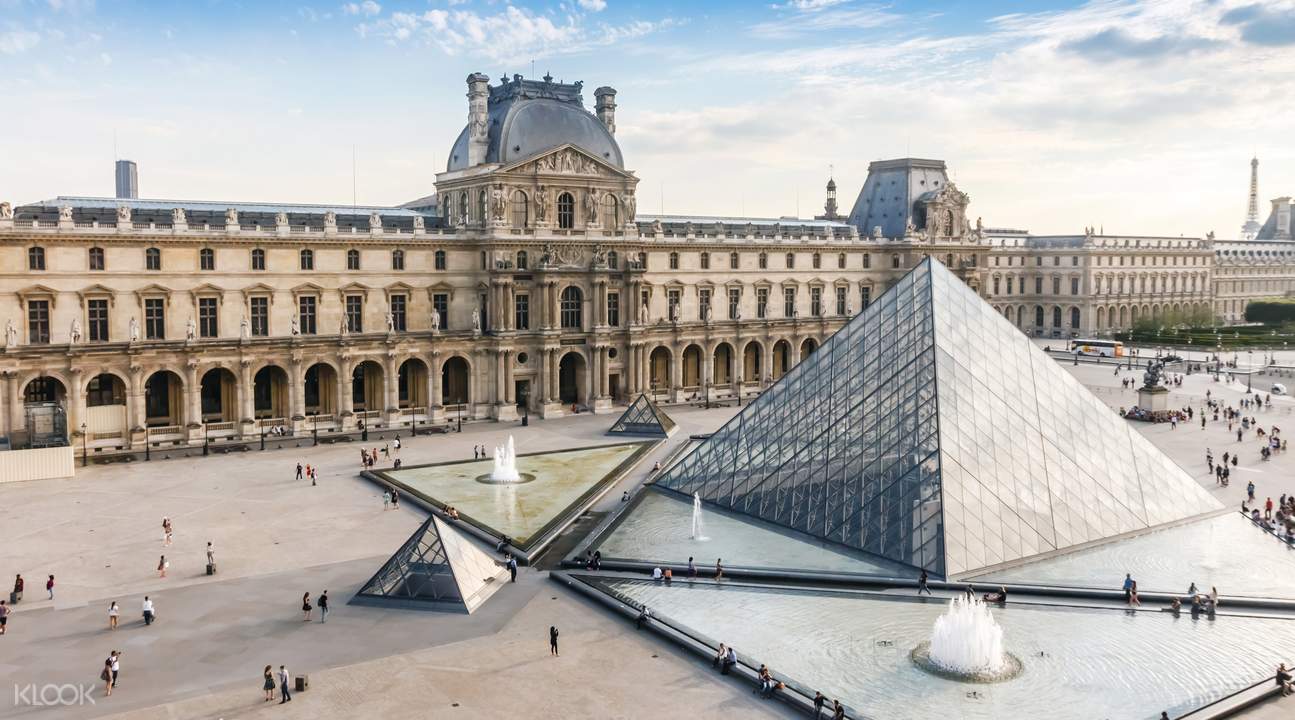
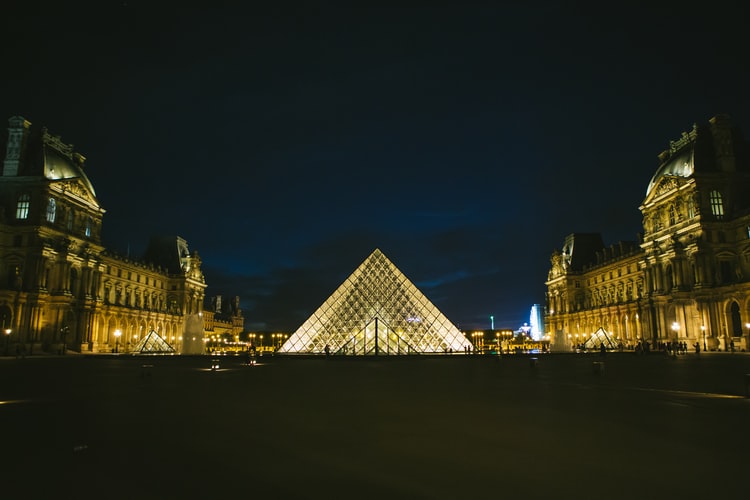
The Louvre is the world’s largest museum and houses one of the most impressive art collections in history. The magnificent, baroque-style palace and museum — LeMusée du Louvre in French — sits along the banks of the Seine River in Paris.
The history of the Louvre began toward the end of 1.100 A.D. in the area where there was a fortress, which later was converted into the royal residence and the secondary residence of Charles V in the 14th century. In the Renaissance period the Louvre became the main seat of the kings of France, and was Catherine de’Medici who enlarged and transformed the building. The Louvre lost its function of royal residence at the time of Louis XIV, who moved his court to the new Palace of Versailles. Since 1793 at the Louvre was created the Muséum Central des Arts, renamed in 1803 the Musée Napoléon.
So, originally the building of the Louvre wasn’t a museum, but became a museum only during the Enlightenment, when artists and craftsmen spent their time admiring and copying the works of the ancients. In the late 18th century and right after the French Revolution, began the acquisition of a large number of works that added to the initial and casual collection of the kings of France, to which were added the works of art coming from the most important European art collections and which arrived in France as spoils of the successful military campaigns of Napoleon.
The Louvre Museum is the result of a long work, started two centuries ago, made of collecting and organizing works and finds in order to create the most completed overview ever of what man has created from the Neolithic to nowadays.

Artist: Leonardo da Vinci
Year: c. 1490
Type: Pen and ink with wash over metalpoint on paper
Location: Gallerie dell’Accademia, Venice
The Vitruvian Man, Italian: Le proporzioni del corpo umano secondo Vitruvio, is a drawing by Leonardo da Vinci around 1490. It is accompanied by notes based on the work of the architect Vitruvius. The drawing, which is in pen and ink on paper, depicts a man in two superimposed positions with his arms and legs apart and inscribed in a circle and square. The drawing and text are sometimes called the Canon of Proportions or, less often, Proportions of Man. It is kept in the Gabinetto dei disegni e stampe of the Gallerie dell’Accademia, in Venice, Italy, under reference 228. Like most works on paper, it is displayed to the public only occasionally. The drawing is based on the correlations of ideal human proportions with geometry described by the ancient Roman architect Vitruvius in Book III of his treatise De Architectura. Vitruvius described the human figure as being the principal source of proportion among the Classical orders of architecture. Vitruvius determined that the ideal body should be eight heads high. Leonardo’s drawing is traditionally named in honor of the architect.
.jpg)
Author: Edvard Munch
Date: 1906
Style: Expressionism
Genre: portrait
Media: oil, canvas
FRIEDRICH NIETZSCHE SHORT BIOGRAPHY
1844-1900
Friedrich Nietzsche was born in Rocken, Saxony (the present-day Germany) on Oct. 15, 1844. He came from a line of Protestant churchman – his father and grandfathers were Lutherman ministers. He studied Classical literature and language at the universities in Bonn and Leipzig. At the age of 24, Nietzsche became a professor at the University of Basel in Switzerland.
After reading the works of the German philosopher Schopenhauer, Nietzsche became a philosopher and began living a life of solitude. He agreed with Schopenhauer that there is no God and life is filled with pain and suffering, but Nietzsche came to his own conclusion that humans must get everything out of life and set out to find out how to best do that.
Nietzsche was totally against religion, in particular Christianity.
Nietzsche proclaimed that “God is dead” in his most famous work, “Thus Spake Zarathustra,” (1883-1892) saying that most people do not believe in God and religion is no longer the foundation for morals. “Thus Spake Zarathustra” was not successful when it was first published, but is now considered a masterpiece in world literature. In 1896, the composer Richard Strauss composed a tone-poem called “Also Sprach Zarathustra” based on Nietzsche’s words.Nietzsche’s works “Beyond Good and Evil” (1886) and “The Genealogy of Morals” (1887) dealt with the origins of moral values. Nietzsche believed that in early civilization the theory of perpetual elimination of the weak by the strong and the incompetent by the competent was correct. But then the Judeo-Christian religion disagreed and said that thought was wrong and the weak and meek shall inherit the earth. What happened was the geniuses, innovators and creators were made equal to the common masses. Nietzsche believed that Christianity’s emphasis on the afterlife make humans less capable of handling life right now.
Nietzsche believed that religious “morality” killed the genius of innovation and could end culture and civilization. Since there is no God, there must be HUMAN creations and realizations. Humans have the “will to power” in politics, culture and everywhere. Nietzsche’s ideal was the super-human-being or the “OVERMAN” or “SUPERMAN”, which is a superior individual who controls his/her passions and uses them in a creative way. The SUPERMAN’S will to power would set him/her apart from the herd of inferior masses. Nietzsche was famous for his much quoted line “What doesn’t kill us makes us stronger.”
In 1889, Nietzsche tragically suffered a nervous breakdown and was overcome by mental illness in his mid forties, allegedly brought on by tertiary syphilis. The actual breakdown started in Turin, where Nietzsche collapsed with his arms around the neck of a horse that was being whipped by a coachman. He became hopelessly insane and on August 25, 1900 at the age 56, Nietzsche died.

( Statue of Odin in Hannover, Germany )
Odin is one of the most complex and enigmatic characters in Norse mythology, and perhaps in all of world literature. He’s the ruler of the Aesir tribe of deities, yet he often ventures far from their kingdom, Asgard, on long, solitary wanderings throughout the cosmos on purely self-interested quests. He’s a relentless seeker after and giver of wisdom, but he has little regard for communal values such as justice, fairness, or respect for law and convention. He’s the divine patron of rulers, and also of outlaws. He’s a war-god, but also a poetry-god, and he has prominent “effeminate” qualities that would have brought unspeakable shame to any historical Viking warrior. He’s worshiped by those in search of prestige, honor, and nobility, yet he’s often cursed for being a fickle trickster.
 European Culture