

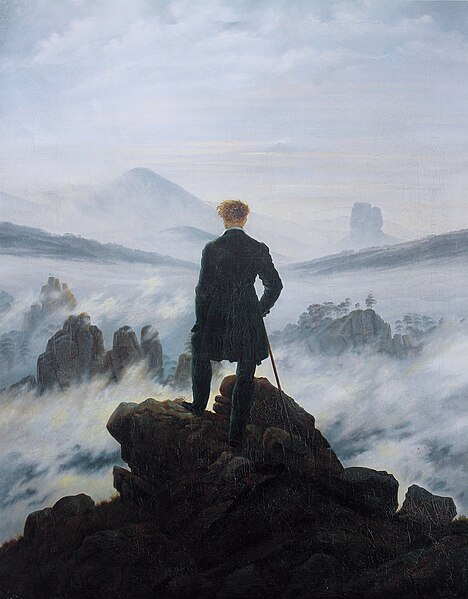
Title: The wanderer above the sea of fog
Artist: Caspar David Friedrich
Year: 1817
Medium: oil on canvas
Wanderer above the Sea of Fog (Der Wanderer über dem Nebelmeer), also known as Wanderer above the Mist or Mountaineer in a Misty Landscape, is an oil painting c. 1818 by the German Romantic artist Caspar David Friedrich. It has been considered one of the masterpieces of Romanticism and one of its most representative works. It currently resides in the Kunsthalle Hamburg in Hamburg, Germany.
In the foreground, a young man stands upon a rocky precipice with his back to the viewer. He is wrapped in a dark green overcoat, and grips a walking stick in his right hand. His hair caught in a wind, the wanderer gazes out on a landscape covered in a thick sea of fog. In the middle ground, several other ridges, perhaps not unlike the ones the wanderer himself stands upon, jut out from the mass. Through the wreaths of fog, forests of trees can be perceived atop these escarpments. In the far distance, faded mountains rise in the left, gently leveling off into lowland plains in the east. Beyond here, the pervading fog stretches out indefinitely, eventually commingling with the horizon and becoming indistinguishable from the cloud-filled sky.
Friedrich’s canvases are intended to promote a meditative state, arising out of the vision and spirit of the artist and communicated to the viewer as an object for contemplation. “The artist,” he wrote, “should not only paint what he sees before him, but also what he sees within him.” Thus he gave these directions to would-be artists, “Close your bodily eye so that you see your picture first with your spiritual eye. Then bring what you saw in the dark into the light, so that it may have an effect on others, shining inwards from outside.

 European Culture